

AI for property managers now handles the repetitive work that eats a working week: answering routine tenant questions, sorting maintenance requests by urgency, and pulling data out of leases and certificates. It doesn't replace the property manager. It removes the admin sitting between them and the decisions that actually need a person. Savills' analysis of AI in property management makes the same point: the value sits in narrow, repetitive tasks, not in replacing judgement.
For a portfolio of any size, that shows up in three places straight away:
- Tenant messages get triaged and answered without someone reading every inbox overnight.
- Maintenance requests get flagged by urgency, so a burst pipe doesn't sit in a queue behind a squeaky door.
- Compliance dates (gas safety, EICR, fire risk assessments) get tracked and chased automatically, rather than living in someone's memory.
Platforms such as Prop Report bring these functions into one system rather than three separate tools.
Pro Tip: Start with the task that generates the most emails or calls. That's almost always where AI pays back its cost fastest.
Key Takeaways
AI for property managers works best when it automates narrow, repetitive tasks, freeing teams to focus on tenant relationships and portfolio decisions.
| Point | Details |
|---|---|
| Automate the narrow tasks | Target tenant triage, maintenance routing and certificate reminders first, not full workflows. |
| Keep a human in the loop | Review automated decisions on tenancies, compliance and finances before they finalise. |
| Choose on integration and security | Prioritise PMS/CRM integration and ISO 27001 certification over flashy features. |
| Pilot one workflow for weeks | Run a single automated workflow for several weeks before expanding. |
| Prop Report as the integrated option | Combines automated reporting, workflow automation and a comms hub under ISO 27001 security. |
Table of Contents
- What AI for property management actually means
- Where AI saves the most time for property teams
- The tangible benefits of adopting AI in property management
- What AI won't do and the risks to plan for
- How to choose an AI tool for property management
- Rapid implementation plan and quick wins to start a pilot
- Prop Report example: why a certified, integrated platform matters
- A publisher's view on where AI actually earns its place
- How Prop Report can help you automate the checklist above
- Sources
What AI for property management actually means
Strip away the marketing language and AI property management software is doing three things: reading text, spotting patterns, and following rules consistently. Large language models handle tenant messages and lease documents. Computer vision reads meter photos or inspection images. Rule-based automation routes the output to the right person or system.
None of this replaces a property manager's judgement on a difficult tenancy dispute or a landlord's decision on a capital repair. It removes the manual steps before that decision gets made.
- Natural language processing reads and categorises tenant emails, texts and WhatsApp messages.
- Document parsing extracts key dates and clauses from leases, certificates and contracts.
- Predictive analytics flags arrears risk or maintenance patterns before they become expensive.
- Computer vision reviews inspection photos for damage or disrepair markers.
Savills' commentary on the sector is blunt about where the real gains sit: automation frees professionals to focus on tenant relationships and portfolio strategy rather than on the paperwork around them, as noted by Savills.
Where AI saves the most time for property teams
Not every workflow benefits equally from automation. Four areas consistently deliver the biggest return for property teams that adopt AI tools for property management.
Tenant communications and helpdesk automation. Chat, SMS and email triage sort incoming messages by topic and urgency, so a request about a broken boiler doesn't wait behind a question about bin collection days. Prop Report's communications hub centralises email, SMS and WhatsApp into one thread per tenant, which cuts the time spent hunting across three apps for the last message. Expected outcome: faster first response and far fewer messages falling through the cracks.
Maintenance triage and vendor routing. AI reads the description of a fault, assigns urgency, creates a work order, and routes it to the right contractor. Prop Report's tenant maintenance call model shows how this looks in practice: a tenant reports an issue, the system classifies it, and a maintenance coordinator gets a prioritised job rather than a raw complaint.

Document analysis and compliance tracking. Lease extraction pulls rent review dates, break clauses and renewal terms without someone reading every PDF. Certificate expiry alerts stop a gas safety check lapsing quietly. This matters for landlords who need evidence trails, not just reminders.
Portfolio analytics and reporting. Automated KPI generation checks the rent roll, flags anomalies like a missed payment pattern, and produces the reports landlords actually want to see.
- Property manager reviews triaged tenant messages instead of reading every one.
- Maintenance coordinator receives pre-classified, routed work orders.
- Landlord gets automated compliance and financial reporting without chasing anyone.
- Vendor receives clearer job briefs, reducing callback visits.
The tangible benefits of adopting AI in property management
The use cases above translate into outcomes landlords and management teams can actually measure. Time saved is the obvious one: fewer hours per week spent reading, sorting and chasing means more time on lease negotiations, void reduction and tenant retention.
Response times improve because messages get sorted the moment they arrive, not when someone opens the inbox. Reactive maintenance costs tend to fall too, since faster triage means smaller problems get fixed before they become expensive ones. Void days often shrink slightly when communication with prospective and existing tenants is quicker and more consistent.
- Fewer manual hours spent on inbox triage and data entry each week.
- Faster acknowledgement and response times for tenant queries.
- More consistent compliance oversight, with fewer missed certificate renewals.
- Better vendor utilisation, since jobs arrive pre-classified and routed correctly.
Savills notes that AI's core value in this sector comes from freeing staff for higher-value work, and portfolios that automate the repetitive layer typically see that time reallocated toward tenant relations and strategic decisions rather than eliminated altogether.
What AI won't do and the risks to plan for
AI in property management still needs a human checking its output, especially anywhere a decision affects a tenant's home or a landlord's compliance record. Treat the following as a working risk checklist before rollout:
- Data security. Tenant and financial data needs storage and handling that meets recognised standards, not a spreadsheet on someone's laptop.
- Incorrect recommendations. A model can misjudge urgency on a maintenance request or misread a lease clause, particularly on non-standard wording.
- Bias in screening. Automated tenant screening or arrears flagging can replicate biased patterns from historical data if nobody checks the outputs.
- Over-automation. Tenants who only ever get chatbot responses tend to disengage; some conversations need a person.
Keep a human in the loop on any decision that affects a tenancy, a compliance deadline or a financial record. Automation should surface the decision faster, not make it alone.
Mitigate these risks with validation workflows before actions go live, audit logs for every automated decision, clear escalation paths when a model flags low confidence, and a periodic review of what the system has actually been doing.
How to choose an AI tool for property management
Pick a platform against a fixed checklist, not a demo that looks impressive. The criteria that actually matter:
- Integration with your existing property management system (PMS) and CRM, not a bolt-on that duplicates data entry.
- Data security certification, such as ISO 27001, which signals independently audited controls rather than a vendor's own claims.
- Customisation to your portfolio's specific policies, escalation rules and reporting formats.
- Auditability, so every automated action leaves a trace you can review or defend.
- Multi-channel communication support across email, SMS and WhatsApp, matching how tenants actually contact you.
Before signing anything, ask vendors these questions directly:
- What does onboarding involve, and how long until the first workflow is live?
- What training data was the model built on, and how is it kept current?
- What is the service-level agreement for uptime and support response?
- How do you handle model drift, and how often are outputs reviewed?
- What does a typical trial period look like, and what counts as success?
Expect a trial to run several weeks against one or two workflows, with pricing scaling by portfolio size or user seats rather than a flat fee.
Rapid implementation plan and quick wins to start a pilot
Start with a single workflow, not a full platform switch. This keeps risk low and makes the return obvious to landlords and colleagues alike.
- Pick one workflow. Tenant message triage or maintenance routing are usually the fastest to show results.
- Map the inputs and outputs. Know exactly what data goes in and what action should come out.
- Set success metrics before you start. Response time, number of automated actions completed, and tenant satisfaction score are the three worth tracking.
- Integrate and run for several weeks. Long enough to see a real pattern, short enough to course correct quickly.
- Review and iterate. Adjust rules based on what the pilot actually surfaced, then expand to a second workflow.
Quick wins to target first: automated acknowledgement messages the moment a tenant gets in touch, certificate expiry reminders that fire weeks ahead of a deadline, and maintenance triage routing that gets a job to the right contractor without a manual handoff. Change management matters here too: tell the team what's automated and what still needs their input, so nobody is surprised when a message gets answered before they've seen it.
Prop Report example: why a certified, integrated platform matters
Consider a management team drowning in three separate inboxes, a spreadsheet for compliance dates, and a CRM nobody updates consistently. Consolidating that into one automated reporting and communications system is exactly the gap Prop Report's platform is built to close.
Its ISO 27001 certification matters here specifically because landlords are trusting a third party with tenant data, financial records and compliance evidence. That's an independently audited security standard, not a vendor's own assurance.
- Automated reporting drawn from real-time property data.
- Workflow automation across maintenance, compliance and communications.
- A centralised comms hub spanning email, SMS and WhatsApp.
- CRM and finance system integration, avoiding duplicate data entry.
An integrated, certified platform means a landlord can trust the reporting they're seeing without separately verifying where the data came from.
A publisher's view on where AI actually earns its place
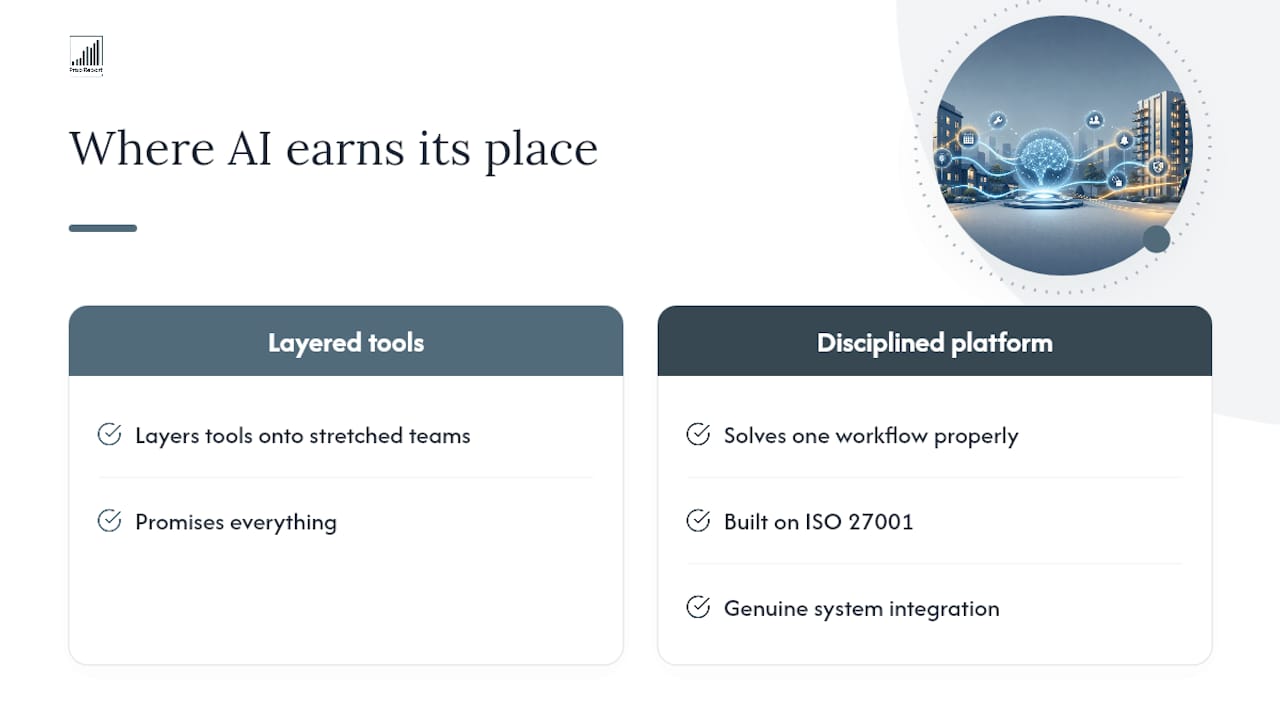
Having watched this sector layer tool after tool onto already-stretched teams, the platforms that stick are the ones solving one workflow properly rather than promising everything. Prop Report's approach, built on ISO 27001 and genuine system integration, reflects that discipline directly.
How Prop Report can help you automate the checklist above
Everything covered in the checklist, from PMS integration to ISO-certified security to multi-channel communications, maps directly onto what Prop Report's AI platform already does. Rather than stitching together separate tools for messaging, compliance tracking and reporting, you get one system that handles all three and integrates with the CRM you already run.
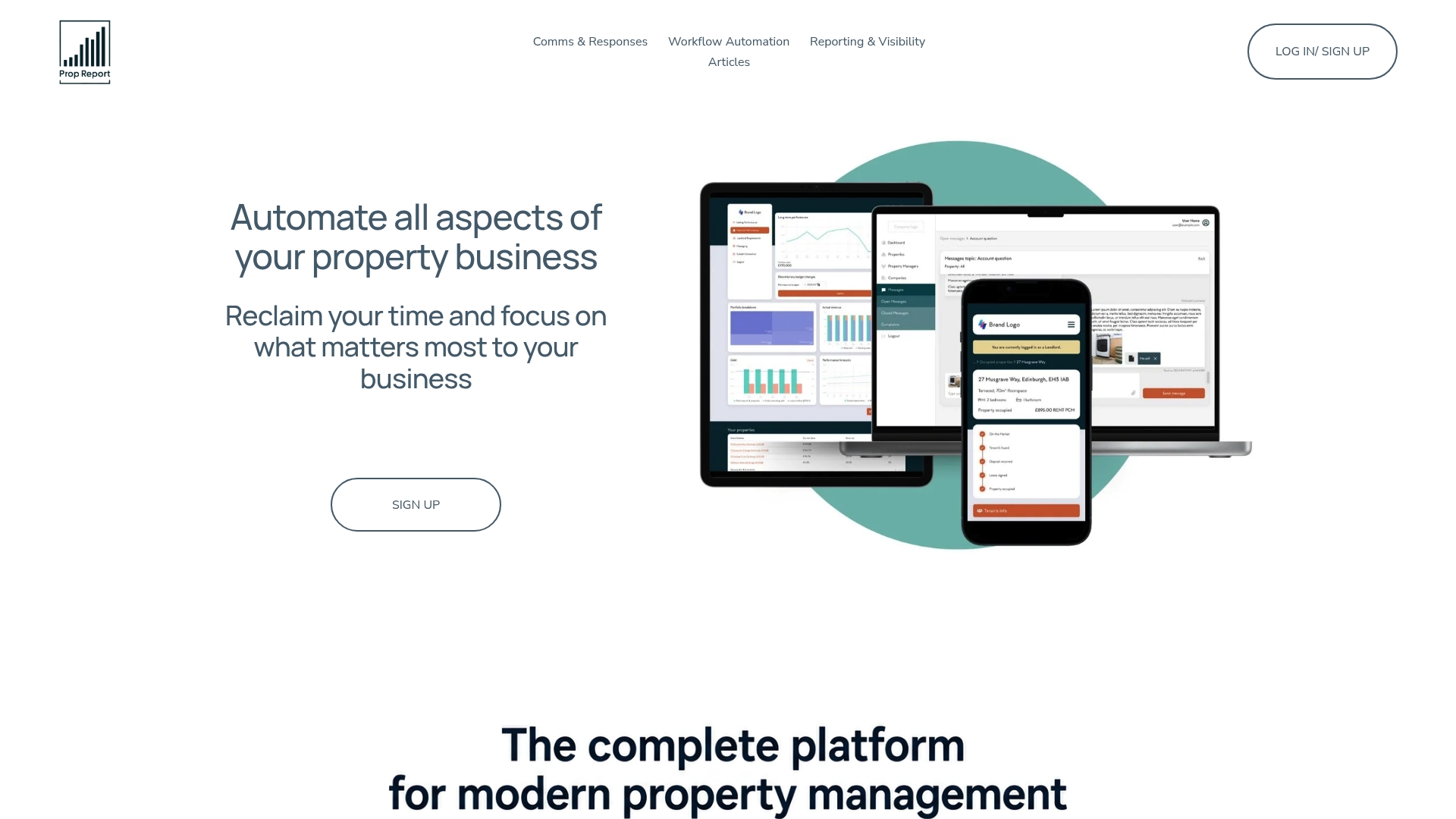
For landlords specifically, the platform's earnings and control features are built around the same real-time reporting and workflow automation covered throughout this guide. If you manage a portfolio and want to see how one workflow (maintenance triage or tenant messaging, for instance) would run on your own data, start a test of Prop Report's AI tools rather than reading another feature list.
Pro Tip: A good demo maps a real workflow from your portfolio onto the platform, using your own data, not a generic example. If a vendor can't show that, ask why.
Sources
- Using AI and tech to improve efficiency in Property ...