

Yes, a live asbestos register is a legal requirement for qualifying non‑domestic buildings in the UK. If you don't have one, commission a management survey now. Where a register already exists, the priority is checking it's current, accessible, and shared with contractors before any work starts, because the register must function as a living document, not a filing-cabinet formality.
TL;DR:
- Updating the asbestos register should occur immediately after any damage, disturbance, or change in the building’s use, not just during the annual review.
- Digital management platforms improve compliance by automating reminders, capturing photographic evidence, and generating contractor notifications.
- Sharing register details before contractor site visits or work planning ensures accurate quotation and risk assessments, reducing delays and safety violations.
- Maintenance staff and contractors must receive asbestos awareness training focused on locating, interpreting, and escalating suspected asbestos issues.
- For refurbishments or demolitions, using the existing register as a starting point prevents costly delays by enabling targeted sampling and clear communication upfront.
Table of Contents
- What must an asbestos register actually contain?
- Who is responsible under CAR 2012?
- How often should you update an asbestos register?
- Practical steps to create or fix an asbestos register today
- How digital systems keep an asbestos register genuinely alive
- Integrating the register with your wider health and safety system
- What training do staff need on the asbestos register?
- Why the register matters most before refurbishment or demolition
- Software tools for managing an asbestos register
- Common mistakes and how to fix your governance
- A simpler way to keep your asbestos register current
- Sources
- FAQ
What must an asbestos register actually contain?
An asbestos register that meets HSE expectations needs several fixed data points for every known or presumed asbestos-containing material (ACM) in the building. The HSE's duty to manage guidance sets the minimum bar, and most registers that fail an inspection are missing one of these:
- Location of the material, described precisely enough that a contractor unfamiliar with the site can find it
- Type and presumed status (confirmed ACM, presumed ACM, or sampled and cleared)
- Extent and quantity, whether that's square metres of ceiling tile or linear metres of pipe lagging
- Condition at the last inspection, and any deterioration since
- Material and priority assessments, which score both the material's friability and the likelihood of disturbance
- Inspection dates, past and next due
Beyond the legal minimum, useful registers add unique reference IDs for each entry, dated photographs, a site plan cross-reference, surveyor details, and a log of actions taken with evidence they were completed. Paper copies still have a place at reception for emergency access, but a digital master that contractors can search before arriving on site is fast becoming standard practice.
Who is responsible under CAR 2012?
The Control of Asbestos Regulations 2012 places the duty on the "dutyholder", which Regulation 4 defines as whoever has clear responsibility for maintenance and repair of non‑domestic premises. In practice that's usually the building owner, the landlord, an employer occupying the space, or a managing agent formally appointed in writing to take on the role.
The duty applies to non‑domestic premises built or substantially refurbished before 2000, since asbestos use in UK construction wasn't fully banned until then. HSE's L143 Approved Code of Practice sets out how the duty should be discharged in detail, and enforcement is real: failing to maintain or share an accurate register can trigger prosecution if a contractor or worker is exposed as a result.
How often should you update an asbestos register?
A register that only gets touched once a year isn't compliant in spirit, even if it technically hits the annual review deadline. HSE expects an active process that captures changes as they happen, not retrospectively.
Update triggers that should prompt an immediate entry, not a wait-and-see approach:
- Annual review as an absolute minimum, even where nothing appears to have changed
- Damage or disturbance discovered during routine maintenance or cleaning
- Change of use in a room or area, which can alter the priority assessment even if the material itself is untouched
- Planned works or refurbishment, before any contractor sets foot on site
- Removal or remediation of any ACM, closed out with certification
- New or repeat surveys, which supersede earlier entries
Inspection cadence should track risk rather than a blanket calendar date. Damaged or high-priority materials in busy corridors need closer attention than intact, low-disturbance items in a locked plant room. Critically, the dutyholder must validate any priority assessment a surveyor supplies, because only the person managing the building day to day knows how a space is really used.
Pro Tip: Log the inspector's name, the date, and a photograph against every entry you update. If an enforcement officer ever asks "how do you know this is current?", that evidence trail is your answer.
Every change needs a date, a named inspector, and photographic evidence where practical, logged as complete rather than left open. Contractors should acknowledge receipt of relevant extracts at quotation stage, not on arrival.
Practical steps to create or fix an asbestos register today
If you're starting from nothing, or inheriting a register nobody trusts, work through these steps in order rather than trying to fix everything simultaneously.
- Commission a UKAS-accredited management survey. Treat any suspect material as asbestos until a sample proves otherwise; this default position, not optimism, is what protects you legally.
- Transfer survey findings into structured register entries. Every material gets a unique ID, a photograph, and a mapped location, not a vague description buried in a PDF report.
- Set re-inspection intervals based on risk, and automate reminders where you can rather than relying on someone remembering. Sign-off on inspections and any resulting actions should sit with a named, accountable person, not left ambiguous.
- Share relevant extracts with contractors at the quotation stage, and capture their acknowledgement in writing. Log every change, however minor, the day it happens.
- Schedule the formal annual management review, plus an informal mid-year sanity check to catch drift before it becomes a compliance gap.
Quick checks worth running on any existing register:
- Do inspection dates match the stated cadence, or has slippage crept in?
- Are priority assessments signed off by the dutyholder, or just copied from the surveyor's report?
- Can a contractor actually locate every entry using the descriptions given?
How digital systems keep an asbestos register genuinely alive
Paper registers and static spreadsheets have a structural weakness: nobody chases them automatically. A re-inspection date slips by a fortnight, nobody notices, and the gap only surfaces when an auditor or enforcement officer asks for evidence. Digital management platforms close that gap by scheduling re-inspections automatically, storing photographic evidence against each entry, and generating contractor notifications that create an audit trail without extra admin.
Whatever system you choose, look for these capabilities as a baseline:
- Exportable register data, so extracts can go to contractors without exposing the entire building's records
- Role-based access, restricting who can edit entries versus who can only view them
- Contractor acknowledgement workflows, logging that information was received and read, not just sent
- Secure storage, ideally with recognised certification such as ISO 27001
- Evidence capture, tying photographs and inspection notes to specific dates and named inspectors
Statistic Callout: The UK's asbestos control limit remains fixed at 0.1 fibres per millilitre as of May 2026, a threshold that hasn't moved in years. That stability is exactly why register accuracy matters more than the regulation itself changing: the risk tolerance is fixed, so the only variable dutyholders control is how well they track what's actually in the building.
Platforms like Prop Report's automation tools are built around exactly this kind of scheduling and evidence-capture problem, applied across the wider compliance calendar rather than asbestos alone.
Integrating the register with your wider health and safety system
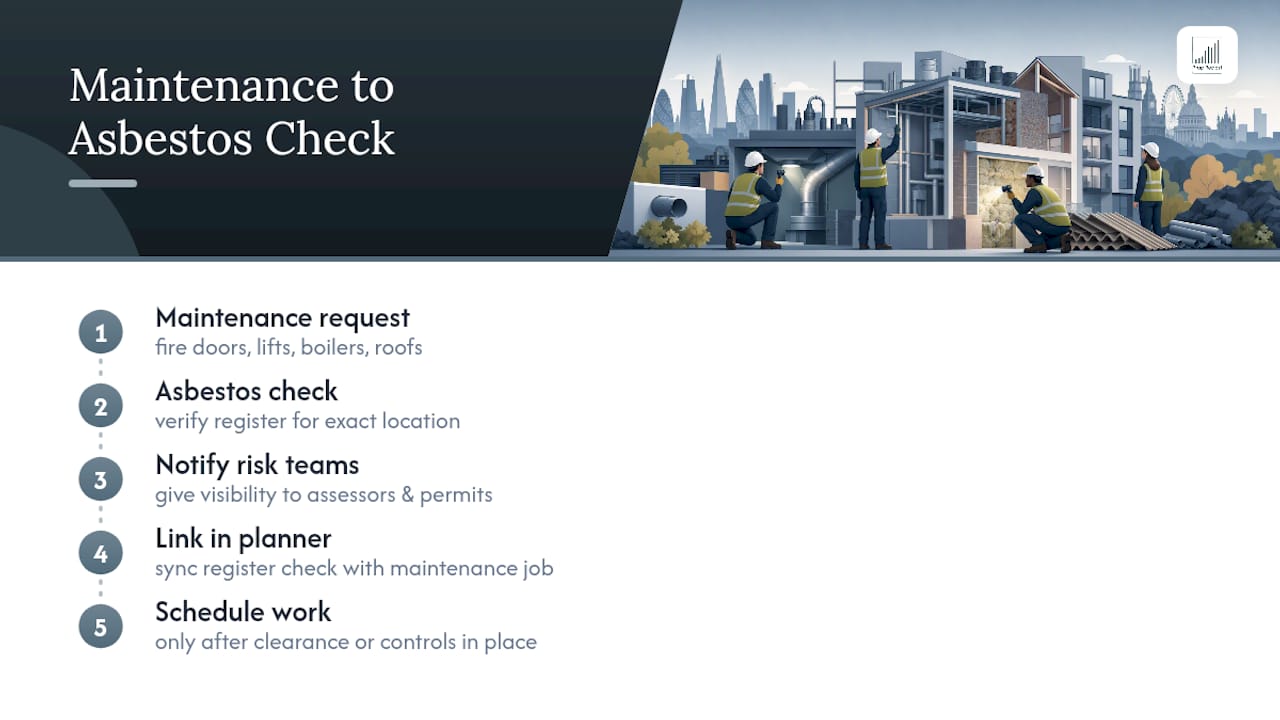
An asbestos register that sits in isolation from the rest of your health and safety management misses half its value. It should feed directly into risk assessments, permit-to-work systems, and maintenance planning, not exist as a separate document nobody cross-references.
In practice, that means the same person or team managing fire risk assessments, legionella controls, and general premises safety should have visibility of the asbestos register too, because these systems overlap constantly. A contractor booked to drill into a wall for a fire door installation needs asbestos information before the job is scheduled, not after they've picked up a tool.
Lift maintenance offers a useful parallel. Engineers routinely need access to plant rooms and shaft areas where older lagging or gasket materials may be present, so lift maintenance reminders and asbestos register checks should trigger together within the same planning system, not run on separate calendars that never talk to each other. The same logic applies to boiler servicing, roof access, and any work touching pre‑2000 fabric.
Building this integration doesn't require an enterprise-grade system from day one. Even a shared calendar linking maintenance jobs to register checks closes most of the gap. What matters is that nobody schedules invasive work without first checking whether the asbestos register flags a risk in that exact location.
What training do staff need on the asbestos register?
Everyone who might disturb the fabric of a building, from in-house maintenance staff to reception teams fielding contractor queries, needs asbestos awareness training as a baseline. That's a different requirement from full asbestos removal licensing; awareness training simply ensures people recognise risk and know where to look.
Staff need to understand three things practically: where the register is kept and how to access it quickly, how to interpret the location descriptions and priority scores without misreading them, and who to contact if they suspect damage to a listed material. A register nobody on site knows how to read is barely better than no register at all.
Facilities and maintenance teams need a slightly deeper level, covering how to log a suspected disturbance, what "presumed" versus "confirmed" ACM status means for their day-to-day work, and how to escalate a concern before continuing a job. Reception or front-of-house staff, meanwhile, mainly need to know how to hand register extracts to visiting contractors and confirm acknowledgement, which is often the weakest link in practice.
Refresher training on a rolling basis, tied to the annual register review, keeps this current without becoming a box-ticking exercise divorced from the actual document.
Why the register matters most before refurbishment or demolition
Refurbishment and demolition projects carry the highest asbestos risk of any building activity, because they involve breaking into fabric that routine maintenance never touches. This is where an out-of-date or incomplete register causes the most damage, sometimes literally.
Before any refurbishment or demolition survey is commissioned, the existing management-survey-based register should be reviewed as a starting point, not skipped. It tells surveyors and contractors what's already known, flags areas that need more invasive sampling, and prevents duplicated effort. A refurbishment/demolition survey goes further than a management survey, because it requires access to areas that would normally be left undisturbed, but it should build on the register rather than start from zero.
Timing here is unforgiving. Sharing register information only after contractors arrive on site is too late; they need it at quotation stage so pricing and method statements reflect the real risk. Projects that skip this step tend to discover asbestos mid-demolition, which stops work entirely and multiplies both cost and delay far beyond what an upfront survey would have cost.
Software tools for managing an asbestos register
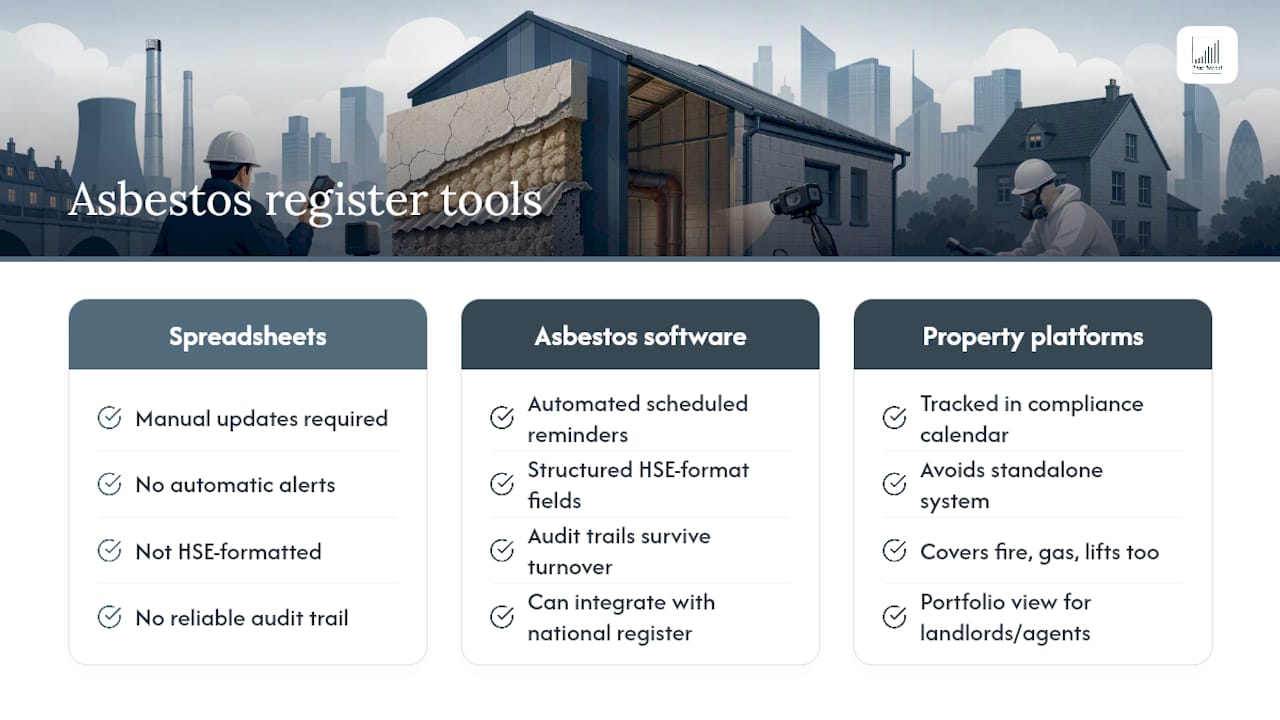
Spreadsheets remain common for smaller portfolios, and they can work if someone disciplined maintains them, but they rely entirely on manual updates and offer no automatic alerts when a re-inspection falls due.
Dedicated asbestos management software closes that gap with scheduled reminders, structured data fields that match HSE's expected format, and audit trails that survive staff turnover. Some platforms integrate directly with the UK National Asbestos Register, letting dutyholders reference building-level data against the national search facility, though the building-level register itself remains the dutyholder's own responsibility regardless of what's uploaded nationally.
Broader property management platforms take a different approach, folding asbestos register tracking into the wider compliance calendar alongside fire risk, gas safety, and lift servicing. That's often more useful for landlords and managing agents juggling multiple statutory duties across a portfolio, since it avoids running asbestos as a standalone system disconnected from everything else. Whichever route you take, the practical test is simple: can a contractor pull the right extract in minutes, and can you prove, with dates and evidence, that every entry was checked when it should have been?
Common mistakes and how to fix your governance
The recurring failure isn't ignorance of the law, it's treating the annual review as sufficient on its own. HSE expects continuous updates, and dutyholders who only touch the register once a year tend to miss damage, disturbance, or changes of use that happened in between.
The second failure is timing: sharing register extracts with contractors after they've already arrived, rather than at quotation stage, when pricing and risk assessment should happen. Vague location descriptions compound both problems, since a contractor who can't find the material described will either search blindly or skip the check.
Fix it with a named responsible person, register entries linked to your maintenance calendar rather than sitting apart from it, and dated photographic baselines with unique IDs on every entry. Then run a quick audit yourself: pull five entries at random and check whether the dates, evidence, and sign-offs actually stand up.
— James
A simpler way to keep your asbestos register current
If juggling spreadsheets, contractor emails, and inspection reminders across a portfolio feels like the real bottleneck, that's the gap Propreport is built to close. Rather than tracking re-inspection dates manually or chasing evidence after the fact, Propreport centralises reminders, photo evidence, and contractor communications in one place, so nothing depends on someone remembering.
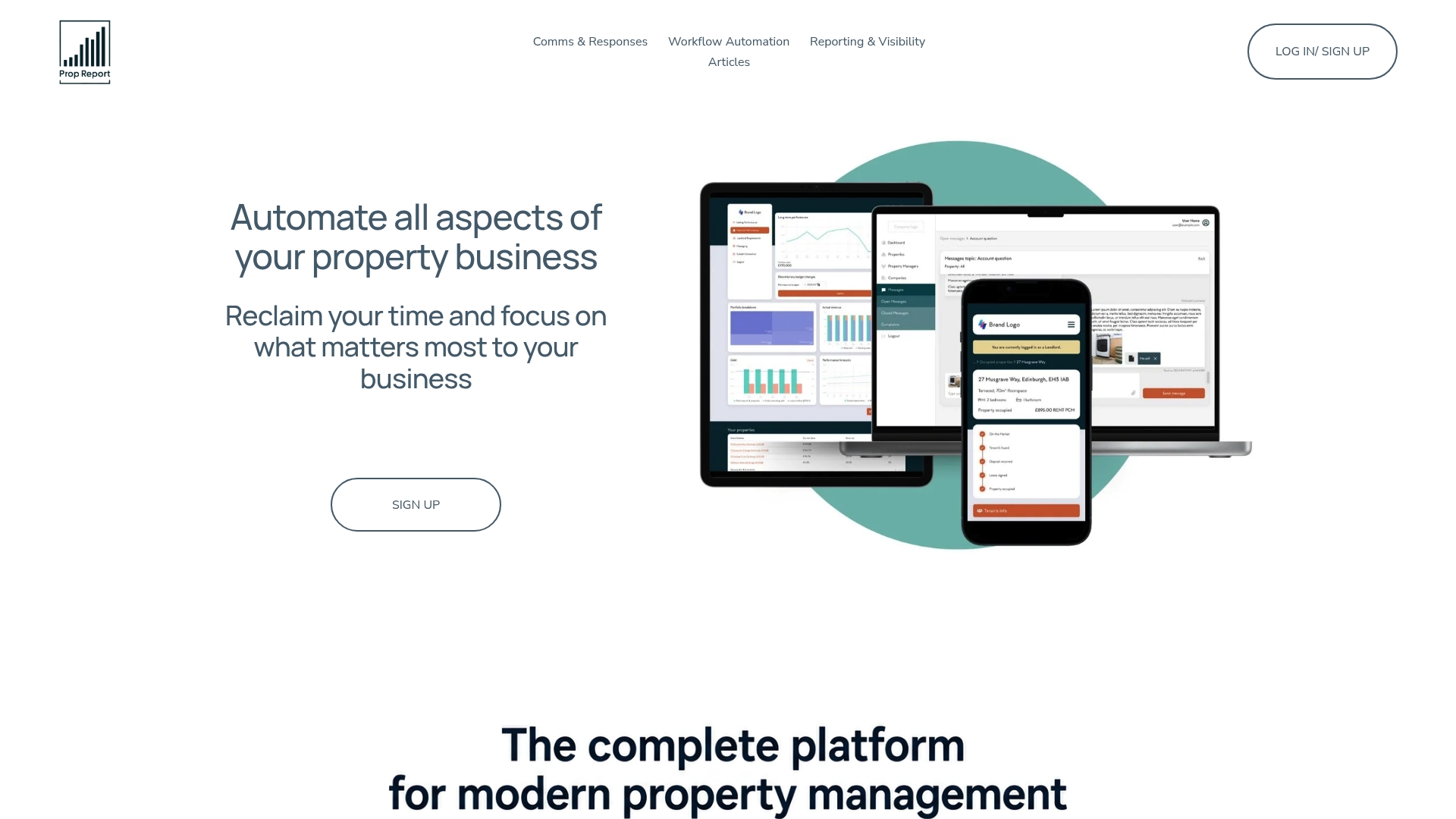
The platform's automation, described on the Arthur property management page, can schedule re-inspections alongside your other statutory compliance tasks, from lift maintenance to fire risk reviews, and export register extracts contractors can actually use before they quote. Data sits behind ISO 27001-certified security, which matters given how sensitive building compliance records are. If your current process relies on someone remembering to update a spreadsheet, it's worth seeing what a connected system looks like. Visit the Propreport landing page to request a demo and see how it fits your portfolio.
Sources
- HSE — The duty to manage asbestos in buildings: Make a register and assess the risk
- HSE press release — asbestos control limit review published (May 2026)
- UK National Asbestos Register — Mesothelioma UK / UKNAR
FAQ
Is there a national asbestos register in the UK?
Yes, the UK National Asbestos Register (UKNAR) provides a searchable database, but it doesn't replace the building-level register a dutyholder is legally required to keep.
Is having an asbestos register a legal requirement?
Yes, under CAR 2012 dutyholders of qualifying non‑domestic premises built or refurbished before 2000 must maintain a live asbestos register.
Who is responsible for managing asbestos in a building?
The "dutyholder" is responsible, typically the building owner, landlord, employer in occupation, or a managing agent formally appointed to take on the role under Regulation 4.
Who do the Control of Asbestos Regulations apply to?
CAR 2012 applies to anyone with clear responsibility for maintenance and repair of non‑domestic premises constructed or substantially refurbished before the 2000 ban, including owners, landlords, and appointed managing agents.
How often does an asbestos register need updating?
At minimum annually, but HSE expects immediate updates whenever damage, disturbance, planned works, or a change of use affects a listed material.