

If you take a deposit for a qualifying private tenancy in England or Wales, you must protect it with the Deposit Protection Service, the Tenancy Deposit Scheme, or mydeposits, and give the tenant prescribed information within 30 days of receipt. Scotland and Northern Ireland run their own approved schemes with different clocks. Miss the deadline and you risk a tribunal claim for up to three times the deposit, so check protection status the moment money changes hands.
TL;DR:
- Protect deposits within 30 days of receipt in England and Wales, with deadlines extending to 30 working days in Scotland and 28 days in Northern Ireland.
- Choose custodial schemes for simplicity and lower risk or insured schemes for cashflow benefits, but always verify fees and renewal terms carefully before committing.
- Keep detailed records of receipt dates, scheme registration, prescribed information delivery, and move-in photographs to avoid tribunal disputes.
- Use platforms like Propreport to automate compliance tasks, evidence storage, and deadline reminders, especially when managing multiple properties.
- Failure to meet jurisdiction-specific deadlines or to provide proper documentation can lead to claims for up to three times the deposit or tribunal enforcement actions.
Table of Contents
- Which deposit protection schemes cover England, Scotland and Northern Ireland?
- Should you choose custodial or insured deposit protection?
- What are the statutory deposit protection deadlines by jurisdiction?
- How does repayment and dispute resolution work at the end of a tenancy?
- Do holding deposits need the same protection as tenancy deposits?
- What compliance workflow prevents deposit protection mistakes?
- Why strict deposit protection habits pay off
- How Propreport keeps your deposit compliance airtight
- Sources
- FAQ
Which deposit protection schemes cover England, Scotland and Northern Ireland?
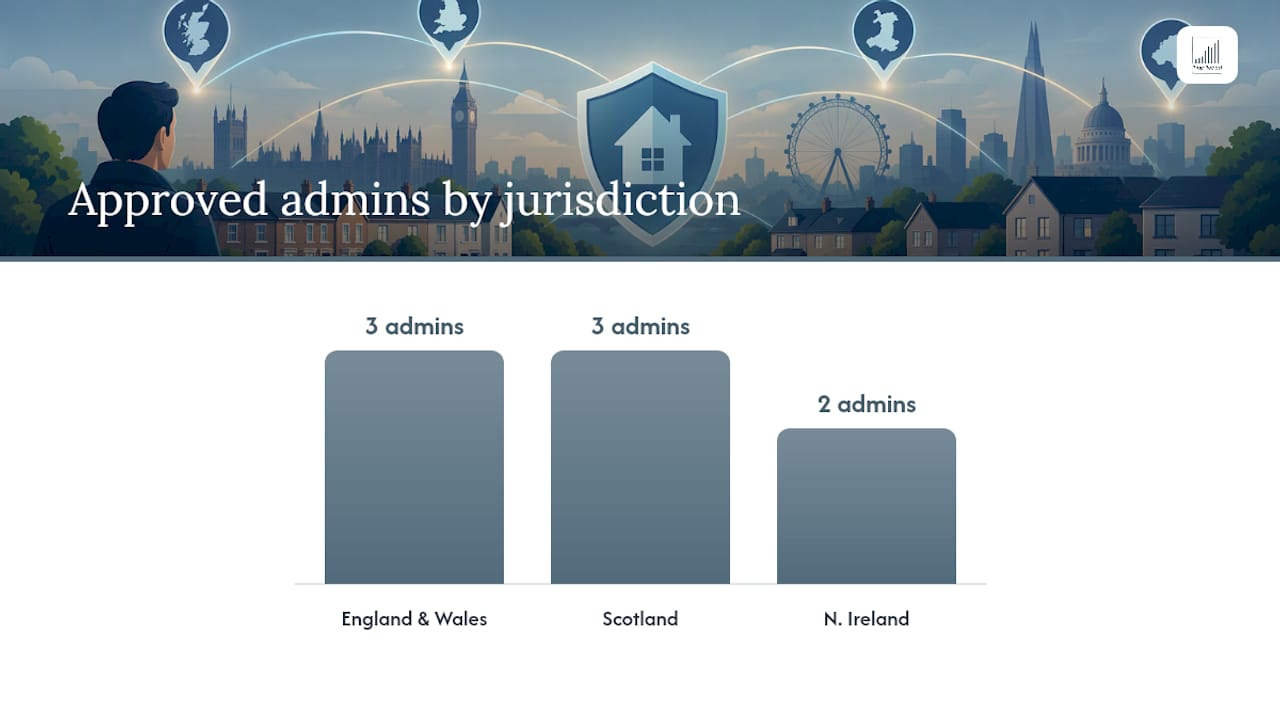
England and Wales share the same three government-approved providers: the Deposit Protection Service (DPS), the Tenancy Deposit Scheme (TDS), and mydeposits. Each offers two protection models, custodial and insured, and it's the landlord or agent who chooses which one to use, not the tenant.
Scotland works differently. Deposits there must be lodged with an approved Scottish scheme within 30 working days, a distinction that matters because working days exclude weekends and bank holidays, effectively giving landlords more calendar time than the figure suggests. The approved Scottish administrators are:
- Letting Protection Service Scotland
- mydeposits Scotland
- SafeDeposits Scotland
Northern Ireland has its own regime again, with mydeposits Northern Ireland and TDS Northern Ireland as the named administrators.
Tenancy type and start date decide which rulebook applies. A Scottish short assured tenancy signed before the current framework, an English assured shorthold agreed last month, and a Northern Irish private tenancy all sit under different statutory clocks. Treat jurisdiction as a fact you record on day one, not something you assume.
Should you choose custodial or insured deposit protection?
Custodial protection is free: the scheme itself holds the money until the tenancy ends. Insured protection lets you keep the deposit in your own account, but you pay the provider a fee for the privilege, and the exact cost varies by scheme.
The practical difference is where the administrative risk sits.
- Custodial: no reconciliation burden, no cashflow benefit, lower risk of a compliance slip.
- Insured: you retain the cash (useful for cashflow), but you must run client-money controls equivalent to what agents already do for rent, including segregation and reconciliation.
Smaller landlords with one or two properties typically favour custodial protection because there's nothing to reconcile and nothing to get wrong. Established agents handling dozens of tenancies often prefer insured schemes, since retaining the funds smooths cashflow across a larger portfolio, provided the back-office discipline is there to support it.
Pro Tip: Before committing to an insured scheme, check the provider's current fee schedule and renewal terms directly. Fees and rules change, and what you paid last year isn't guaranteed to apply this year.
What are the statutory deposit protection deadlines by jurisdiction?
The deadline you're working to depends entirely on where the property sits, and getting the jurisdiction wrong is one of the easiest ways to breach the rules without realising it.
- England & Wales: 30 days from receipt to protect the deposit and issue prescribed information, for assured and assured shorthold tenancies. The Renters' Rights Act is reshaping tenancy structures, so check current transition guidance if you're mid-conversion to a new tenancy type.
- Scotland: 30 working days to lodge the deposit and supply the required information.
- Northern Ireland: 28 days to protect the deposit, and a separate 35-day window to provide written scheme information.
Prescribed information itself is largely consistent across schemes: the deposit amount, the property address, the scheme name and contact details, how the tenant applies for its return, and how to access the scheme's dispute resolution service. Get any element wrong and you've technically failed the requirement, even if the money itself was protected on time.
How does repayment and dispute resolution work at the end of a tenancy?
Once landlord and tenant agree on the amount due back, the deposit should be returned within 10 days. That's the easy scenario. Disagreement is where most people get anxious, and it's worth knowing the process is far less adversarial than it sounds.
If you can't agree, the deposit stays protected while the scheme's alternative dispute resolution (ADR) service reviews the case. Nobody loses access to the money; it simply sits with the scheme until an adjudicator decides.
Adjudication is evidence-led, and good check-in and check-out documentation materially improves outcomes. Gather before you need it:
- A signed inventory from move-in
- Dated check-in and check-out photographs
- Receipts for cleaning, repairs, or replacement items
- Any repair invoices tied to disputed damage
To raise or respond to a dispute, log into the relevant scheme's portal, submit your evidence within the window it sets, and let the adjudicator weigh both sides. There's no court appearance and no legal fee, which is precisely why solid records make the whole process feel administrative rather than confrontational.
Do holding deposits need the same protection as tenancy deposits?
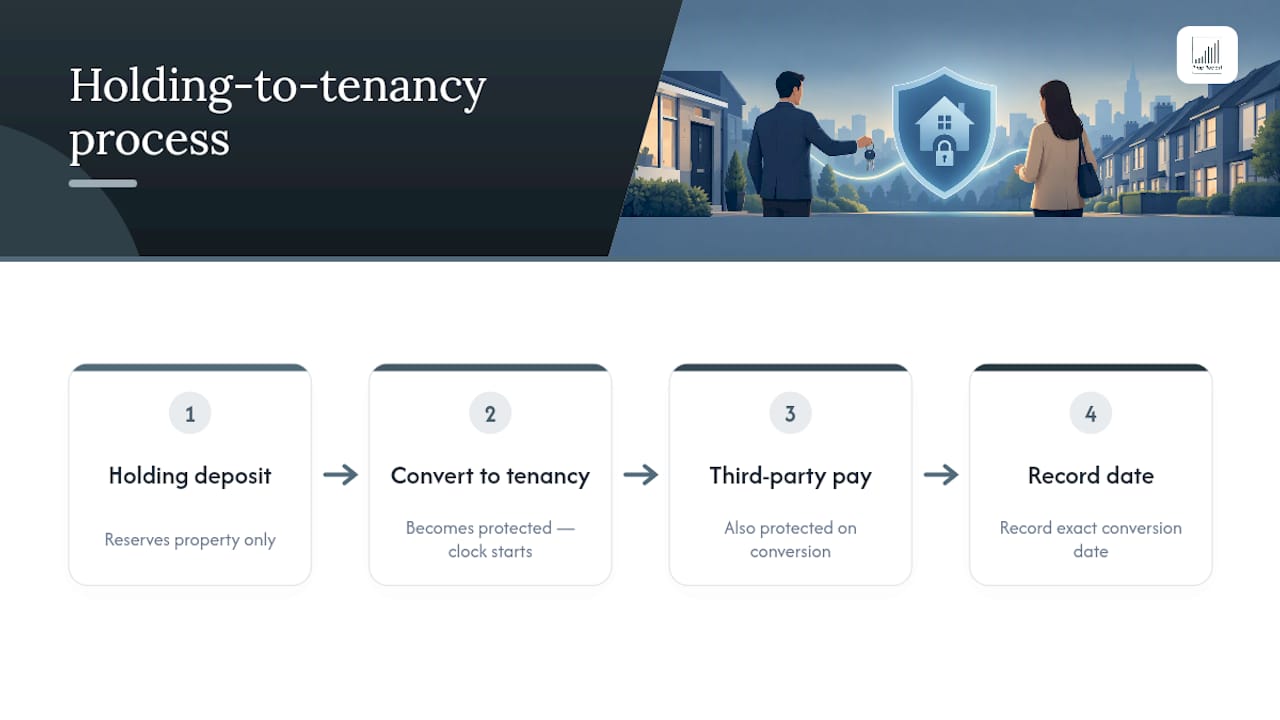
A holding deposit reserves the property and generally doesn't need protecting while it remains just that. The moment you apply it towards the actual tenancy deposit, though, it becomes a protected sum and the statutory clock starts.
The same applies when a parent or guarantor pays on the tenant's behalf: third-party payments still require protection once converted. Record the exact date of conversion in writing, because that date, not the date the holding deposit first arrived, is what a scheme or tribunal will ask for.
What compliance workflow prevents deposit protection mistakes?
Most failures aren't wilful. They're missed dates, lost paperwork, or nobody quite remembering who sent the prescribed information. A simple sequence closes most of the gaps:
- Record the exact receipt date, payer, and amount the moment the deposit lands.
- Classify the tenancy's jurisdiction and calculate the specific deadline it triggers.
- Register or lodge the deposit with the correct provider and keep the certificate.
- Send prescribed information and retain proof of delivery, not just proof you drafted it.
- Store the check-in inventory and photographic evidence somewhere it won't get lost between team members.
- Reconcile any retained sums against client-money records if you're running insured protection.
- Diarise the end-of-tenancy check and the ADR response window well before either arrives.
Property managers running multiple tenancies find that folding these steps into a central workflow, rather than tracking them across spreadsheets and inboxes, is what actually prevents the missed certificate or the lost delivery receipt. Platforms built for landlord operations can automate the reminders and hold the evidence in one place, which matters most exactly when you're juggling twenty tenancies instead of one.
Pro Tip: Store the registration certificate, the prescribed information, and proof it was sent together as one record per tenancy. Adjudicators ask for all three, and hunting through separate systems under time pressure is how good cases get lost on paperwork alone.
Why strict deposit protection habits pay off
Landlords who protect deposits on time and document everything as they go rarely end up in a tribunal. The ones who do end up there almost always share the same root cause: a missing certificate, an undelivered prescribed information pack, or no photographs from move-in. Organised records turn a potential dispute into an administrative formality rather than a fight, and that protects the tenancy relationship as much as it protects the money.
— James
How Propreport keeps your deposit compliance airtight
Propreport is the alternative to juggling spreadsheets, email threads, and paper certificates across a growing portfolio: one centralised system that automates the reporting, evidence storage, and reminders that deposit compliance actually depends on.

The platform provides automated data reporting to help keep registration certificates, prescribed information, and delivery proof stored against each tenancy, helping reduce risks of lost information. Its communications hub logs every message to tenants, which matters when a scheme asks for proof that prescribed information actually arrived. Diary automation flags protection deadlines and ADR windows before they're missed, and the platform implements data security measures to keep that evidence protected. If you're managing more than a handful of tenancies, take a look at Propreport's pricing plans, starting at £10 a month for the Individual plan, and see which tier fits your portfolio.
Sources
Confirm the rules directly at GOV.UK, Shelter England, and Citizens Advice.
- Gov
- What should happen when you pay a deposit? - Shelter England
- Tenancy deposit scheme information for landlords - nidirect
- Review of tenancy deposit schemes (Scotland) - Scottish Government
FAQ
What is the best deposit protection scheme in the UK?
There isn't a single "best" scheme; the DPS, TDS, and mydeposits all meet the same statutory standard in England and Wales. The better question is custodial versus insured, since that choice affects your administrative workload far more than which provider's logo is on the certificate.
What are the deposit schemes in the UK?
England and Wales use the Deposit Protection Service, the Tenancy Deposit Scheme, and mydeposits. Scotland runs Letting Protection Service Scotland, mydeposits Scotland, and SafeDeposits Scotland, while Northern Ireland uses mydeposits Northern Ireland and TDS Northern Ireland.
What are the three deposit protection schemes?
This usually refers to England and Wales specifically: the Deposit Protection Service, the Tenancy Deposit Scheme, and mydeposits. Scotland and Northern Ireland have their own separate sets of approved administrators.
What are the deposit protection regulations in the UK?
Regulations require landlords to protect a qualifying deposit in an approved scheme and provide prescribed information within a set deadline, which is 30 days in England and Wales, 30 working days in Scotland, and 28 days (plus 35 days for information) in Northern Ireland. Failure to comply can expose landlords to a tenant claim for compensation.
How do I check if my deposit is actually protected?
Ask your landlord or agent for the scheme name and your deposit's protection certificate, then verify it directly with the provider. Citizens Advice sets out the exact steps tenants can take if a landlord can't produce one.