

Digital transformation in property management means replacing manual, paper-based workflows with connected software, automation, and real-time data so managers spend less time chasing information and more time making decisions. The immediate action for most operators is narrow: pick one workflow, such as maintenance ticketing, and run a focused pilot before touching anything else. Get that right and the wider rollout looks after itself.
TL;DR:
- Focusing on one high-value workflow, such as maintenance requests, and running a pilot helps ensure successful broader digital adoption.
- Core technologies like cloud systems, AI, IoT, and integrated portals require cohesive interoperability to deliver meaningful value.
- Establishing clear KPIs and data readiness before scaling pilots minimizes wasted effort and ensures measurable progress.
- Security must be embedded from the start, with ISO 27001 certification serving as a key indicator of a vendor's systematic data protection controls.
- Common pitfalls include unclear workflows, vague success metrics, insufficient training, chaotic data, and vendor selection based on features rather than fit.
Table of Contents
- Why digital transformation matters now: measurable benefits
- Core technologies property managers should prioritise
- Implementation roadmap: pilot, measure, scale
- Which workflows to automate first and why
- Data governance and security essentials, and where ISO 27001 fits
- How to measure success: KPIs and a simple ROI calculation
- Client example: Prop Report's role in streamlining reporting and operations
- Five mistakes that sink digital transformation projects
- See how Prop Report handles the workflows this article describes
- Sources
Why digital transformation matters now: measurable benefits
Manual reporting, scattered spreadsheets, and phone-tag maintenance requests cost property managers far more than most budgets admit. A systematic review of digital transformation in real estate confirms that operational efficiency, decision-making speed, and tenant engagement all improve once organisations move core processes onto connected platforms, though the same review flags data quality and integration as recurring obstacles.
The practical gains tend to cluster around three areas:
- Efficiency: fewer manual handoffs mean tickets close faster and rent statements go out on time.
- Tenant experience: self-service portals and instant repair updates cut the volume of "just checking in" calls.
- Oversight: consolidated dashboards replace the guesswork of chasing five different spreadsheets for one answer.
Statistic Callout: Poor process visibility and disconnected systems are named among the leading causes of stalled digital projects, according to Harvard Business Review's guidance on scaling pilots — not the technology itself, but the absence of clear goals before automation begins.
Core technologies property managers should prioritise
Chasing every new platform on the market wastes budget. The categories that actually move the needle are consistent across most portfolios:
- Cloud property management systems — a single system of record replaces duplicated spreadsheets and email threads, giving every stakeholder the same numbers.
- AI and machine learning — predictive maintenance flags failing boilers or lifts before they break, and ticket prioritisation routes urgent repairs ahead of routine ones.
- IoT sensors — environmental and condition monitoring (leaks, temperature, occupancy) turns reactive maintenance into scheduled maintenance.
- Tenant portals and mobile apps — centralise communications so requests, payments, and updates sit in one thread rather than fragmented across email, SMS, and WhatsApp.
- Integration layers and APIs — connect finance systems and CRM platforms so data entered once flows everywhere it's needed, rather than being retyped three times.
None of these technologies deliver value in isolation. The return comes from how well they talk to each other, which is exactly where most legacy-system integrations stall.
Implementation roadmap: pilot, measure, scale
A staged rollout beats a big-bang launch almost every time, largely because it lets you catch mistakes while they're still cheap to fix.
- Map the process first. Choose one high-value workflow, maintenance requests or move-in checklists work well, and document every step, owner, and handoff before automating anything.
- Define KPIs before you build. Decide what "success" looks like (ticket resolution time, vacancy days, tenant satisfaction) before automation goes live, not after.
- Check data readiness. Audit which systems hold the data you need and prioritise integrations that remove double entry first.
- Run pilot governance properly. Assign an owner, train the pilot team properly, and keep stakeholders briefed on progress weekly.
- Apply scale criteria. Only roll out wider once the pilot hits its predefined KPIs, HBR's research on scaling pilots is blunt about this: scaling without agreed success metrics is a leading cause of wasted transformation spend.
Pro Tip: Set your stop or go threshold in writing before the pilot starts. Teams that agree success criteria in advance rarely argue about whether to scale, because the answer is already on paper.
Which workflows to automate first and why
Maintenance, move-in, and renewal flows deliver the fastest return because they repeat constantly and involve the most manual handoffs between tenants, contractors, and managers.
- Maintenance requests benefit from automated triage and contractor dispatch, cutting the back-and-forth that eats up a coordinator's day.
- Move-in checklists reduce disputes when inspection steps, signatures, and confirmations are logged automatically rather than trusted to memory.
- Renewals improve when reminder sequences and rent-review templates fire on schedule instead of relying on someone remembering a date.
Document who owns each trigger and confirmation step before automating; workflow guidance for maintenance, move-in, and renewal processes shows that unclear ownership, not the software, is what causes steps to get skipped. Keep judgement calls (rent negotiations, difficult tenant disputes, contractor disagreements) human-in-loop. Automation should remove repetitive admin, not decision-making that needs context.
Data governance and security essentials, and where ISO 27001 fits
Security has to be a procurement requirement, not an afterthought bolted on after go-live. A basic checklist before signing with any vendor:
- Role-based access controls so only the right people see financial or tenant data.
- Encryption and audit trails covering data at rest and in transit, with a clear record of who accessed what.
- Incident response basics — a documented plan for breach notification, not a vague promise.
- Data portability — confirm you can export your own data if you ever switch providers.
ISO 27001 certification indicates a vendor follows recognised, systematic controls for confidentiality, integrity, and availability of data, rather than an informal internal policy. It's a meaningful signal in vendor evaluation precisely because it's independently audited. Security certifications like this matter enough to procurement panels that they're worth listing explicitly on your demo checklist rather than assuming they exist.
How to measure success: KPIs and a simple ROI calculation
Keep the KPI set small enough to actually track weekly. Five numbers tell most of the story:
- Average time per maintenance ticket
- Vacancy days between tenancies
- Move-in turnaround time
- Tenant satisfaction score
- Reporting time saved per manager per week
For ROI, a simplified formula works well for pilots: (hours saved per week × cost per hour × 52) minus (subscription cost + implementation cost). Review that number monthly during the pilot, then quarterly once scaled, and put it on a dashboard stakeholders can check without asking you for an update.
Client example: Prop Report's role in streamlining reporting and operations
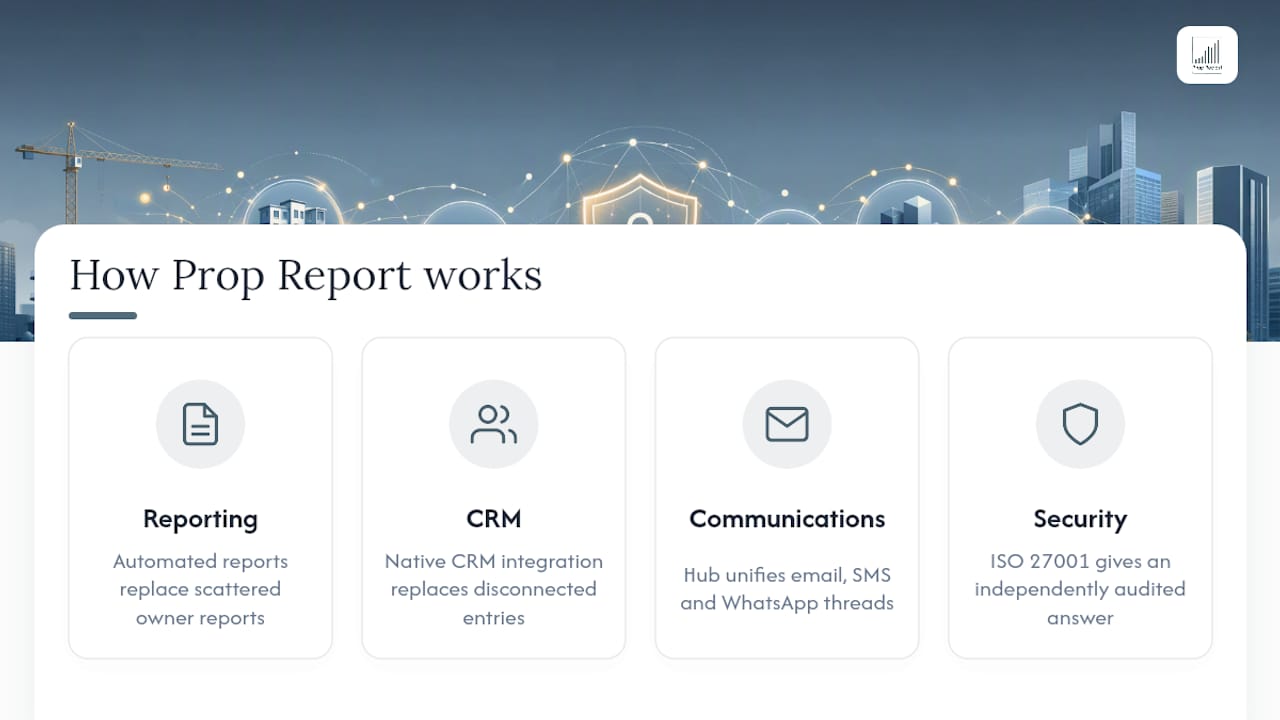
Prop Report consolidates automated reporting, CRM integration, and a centralised communications hub, covering email, SMS, and WhatsApp, into one platform, addressing exactly the fragmentation described earlier. The platform holds ISO 27001 certification, a differentiator that matters when data security sits on your procurement checklist rather than as a nice-to-have.
Picture a portfolio manager juggling five owner reports every Friday from five separate spreadsheets. With reporting automated and integrated with the existing CRM, that same manager can see live occupancy, maintenance status, and financials in one dashboard, and answer an owner's question in the time it takes to open the app.
Before committing to any platform, ask at the demo:
- Which CRM and finance systems does it integrate with natively?
- Can you export your data fully if you switch providers later?
- What SLAs cover uptime and support response?
- What onboarding support is included in the first 90 days?
Pro Tip: Bring your messiest owner report to the demo and ask the vendor to rebuild it live. Most sales decks look polished, few can handle your actual data on the spot.
Five mistakes that sink digital transformation projects
The pattern repeats across most failed rollouts: no mapped workflow before automating, KPIs left undefined, training skipped to save time, data too chaotic to trust, and vendors chosen for feature lists rather than fit with existing systems.
Protect a project politically by naming an executive sponsor early and publishing pilot results, good or bad, so the initiative can't be quietly starved of resource. Bring your demo checklist and insist vendors answer the integration and data-portability questions directly. Vague answers there predict vague support later.
— James
See how Prop Report handles the workflows this article describes
If you recognised your own Friday afternoon in that spreadsheet scenario above, that's the gap Prop Report was built to close. It replaces scattered owner reports and disconnected CRM entries with one platform: automated reporting, native CRM integration, and a communications hub that keeps email, SMS, and WhatsApp threads in one place. The inefficiency this solves is real. Managing multiple properties through disconnected tools can drain a substantial amount of money per manager each year in lost time, and that figure sits at the centre of why Prop Report exists. Its ISO 27001 certification gives buyers an independently audited answer to the security questions raised in any procurement process. Explore the AI-driven property management features or check the landlord-focused overview to see how reporting and communications consolidate in practice, then book a demo to test it against your own messiest report.
Sources
For deeper evidence on outcomes and pitfalls, see the systematic review of real estate digital transformation, HBR's guide to scaling pilots, and practical workflow templates for rental processes. For risk-transfer context alongside data-driven oversight, see this property insurance resource.
- Digital transformation in the real estate industry: A systematic literature review of current technologies, benefits, and challenges
- How to scale a successful pilot project