

Yes, UK GDPR applies to every landlord and property manager, whether you own one flat or oversee a portfolio of 400. Start by working out whether you're a data controller or processor, issue a privacy notice the moment you collect tenant information, and lock down anything sensitive, financial records, ID documents, references, before you do anything else. The Data Protection Act 2018 gives the Information Commissioner's Office real teeth here, and the clock on fixing gaps starts now, not after your first complaint.
TL;DR:
- Landlords and property managers must clearly define whether they are data controllers or processors to meet UK GDPR obligations and avoid liability issues.
- Proper documentation of processing activities, including lawful basis and retention periods, is essential for demonstrating compliance during ICO investigations.
- Managing CCTV, subject access requests, and data breaches requires strict procedures, timely actions, and accurate record-keeping to avoid severe penalties.
- External processors and contractors must sign Data Processing Agreements that specify security, sub-processing, breach notification, and audit rights.
- Automating GDPR compliance through centralized platforms helps maintain ongoing adherence and reduces human error, especially for larger portfolios.
Table of Contents
- Does UK GDPR apply to your property business?
- Lawful bases for everyday property management activities
- Writing a privacy notice tenants will actually read
- How long should you keep tenant records?
- Building practical security into a property management operation
- When you need a Data Protection Impact Assessment
- Vetting the third parties who touch your tenant data
- CCTV and monitoring in shared spaces
- Handling breaches and subject access requests properly
- Your GDPR compliance checklist for property management
- How automated platforms strengthen your compliance evidence
- Making GDPR part of daily operations, not a one-off project
- Get GDPR compliance built into your daily workflow with Propreport
- Sources
Does UK GDPR apply to your property business?
Personal data is any information that identifies a living person, directly or indirectly. A tenant's name, email address, bank details, National Insurance number, even a CCTV image of them walking through a communal hallway, all count. Under UK GDPR and the Data Protection Act 2018, the organisation or individual who decides why and how that data gets processed is the controller. The organisation that processes it on someone else's instructions, without setting the purpose, is the processor.
A private landlord letting a single flat is still normally a controller. You decide what information to collect during referencing, why you keep bank details, and how long you retain a former tenant's file. Size doesn't exempt you. Neither does the fact that you don't call yourself a "business."
Letting agents and managing agents usually sit in a dual role. When an agent runs referencing, handles rent collection and manages the tenancy on the landlord's behalf using its own judgement about processes, it's often a controller in its own right, not merely a processor acting on instruction. Where an agent operates strictly to a landlord's specific instructions with no independent decision making, it may be a processor. In practice, most letting arrangements involve joint or separate controllership, which is why the relationship needs writing down rather than assumed.
Common processor relationships in property management include:
- Referencing agencies, which check credit history and previous landlord references on your instruction
- Cloud platforms and property management software, which store and process tenant records on your behalf
- Contractors and maintenance firms, who may see tenant contact details or access notes to arrange repairs
- Payment processors, handling rent collection and deposit transfers
The practical consequence of getting this wrong is liability. If a contractor mishandles tenant data and you never established who was controller and who was processor, the ICO can pursue either party, and your defence weakens considerably without a documented relationship. LexisNexis guidance on the sector makes clear that this distinction drives everything downstream: who chooses the lawful basis, who responds to a subject access request, and who has to sign a Data Processing Agreement before data changes hands.
Lawful bases for everyday property management activities
You can't process tenant or landlord data just because it's convenient. UK GDPR requires a lawful basis for every processing activity, and property management typically draws on four of the six available bases.
- Contract covers most of the tenancy relationship itself: collecting rent, managing repairs, handling deposit registration and communicating about the tenancy agreement. If the processing is necessary to perform the tenancy contract, contract is usually your basis.
- Legal obligation applies where you're required by law to process data, right to rent checks, anti-money laundering checks for certain transactions, or retaining records for tax purposes.
- Legitimate interests covers activities like fraud prevention during referencing, basic credit checks, or using CCTV in communal areas to protect residents and property. This basis requires a balancing test, not just an assertion.
- Consent is the narrowest and most misused basis. It's appropriate for optional marketing emails or newsletters, but consent must be freely given, specific, and easy to withdraw. Landlords who tick "consent" for core tenancy processing are usually choosing the wrong basis; if withdrawing consent would break your ability to manage the tenancy, consent was never the right fit.
Running a legitimate interests assessment doesn't need to be complicated, but it does need to be recorded. Ask three questions: what's the purpose, is processing necessary to achieve it, and does the individual's interest override yours? For CCTV in a shared entrance, the purpose is usually resident safety and crime deterrence, the processing is necessary because there's no less intrusive alternative, and provided retention is limited and access is restricted, the balance typically favours the landlord. Write that reasoning down. An unrecorded balancing test looks identical to no balancing test at all if the ICO ever asks.
A simple mapping exercise makes this concrete. Referencing and credit checks typically rest on legitimate interests, documented with a balancing test on file. Rent collection and repair coordination sit on contract, evidenced by the tenancy agreement itself. Right to rent verification rests on legal obligation, with copies of checked documents retained per Home Office guidance. Marketing emails about new services need consent, recorded with a timestamped opt-in. CCTV footage in communal areas usually rests on legitimate interests, with a written balancing test and clear retention limit.
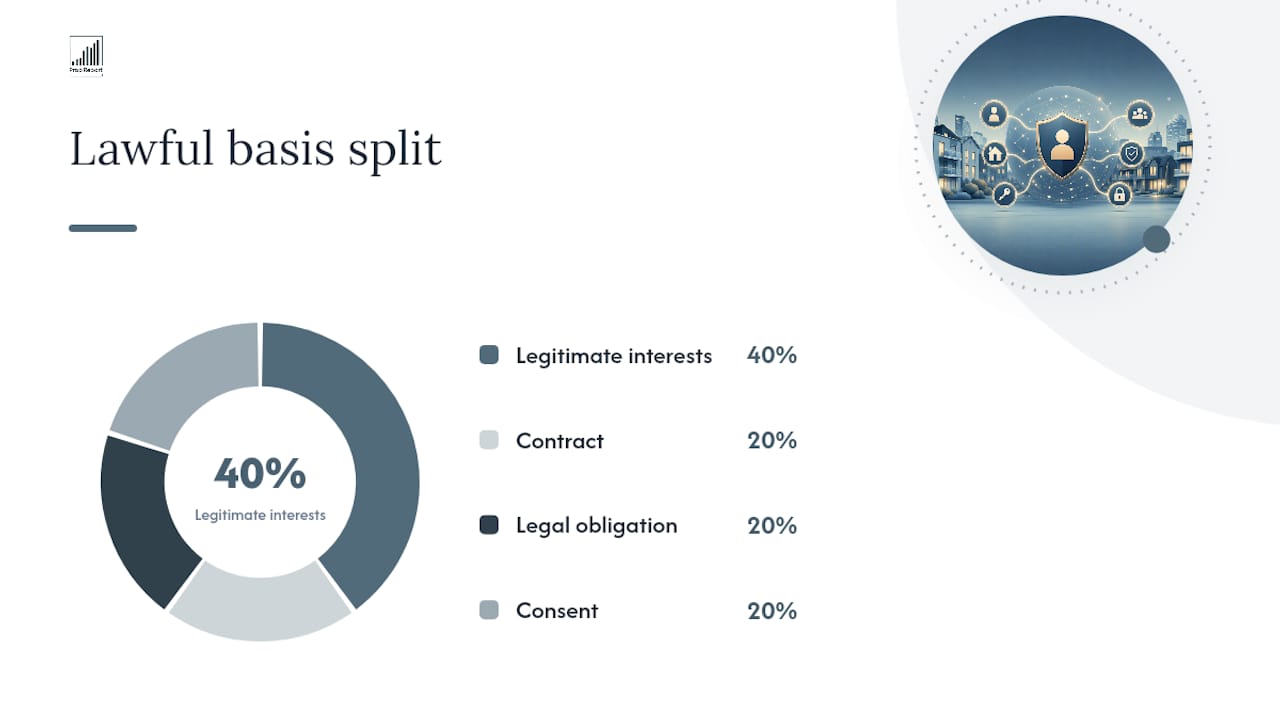
Document which basis applies to which activity in your record of processing activities. If you can't say, in one sentence, why you're allowed to hold a piece of data, you probably shouldn't be holding it yet.
Writing a privacy notice tenants will actually read
A privacy notice isn't a legal formality buried in the small print, it's the document that proves you told people what you were doing with their data before you did it. UK GDPR requires this transparency at the point of collection, not retrospectively when someone complains.
Every privacy notice needs to cover a defined set of elements. Miss one and the notice technically fails the transparency requirement, even if everything else is perfect.
- Identity of the controller — your name or company name, and contact details
- Purposes of processing — why you're collecting this specific information
- Lawful basis — which of the four bases from the previous section applies
- Retention period — how long you'll keep the data, or the criteria used to decide
- Data subject rights — access, rectification, erasure, objection, and how to exercise them
- Contact details — for queries or complaints, including the right to complain to the ICO
Where you present this matters as much as what it says. Tenancy application forms need at least a short-form notice at the point of collection, with a link to the full version. Tenant portals and onboarding emails are good places for the extended notice. Tenancy agreements should reference the privacy notice explicitly rather than trying to cram it into a clause nobody reads. Rent Smart Wales guidance for landlords and agents recommends treating the notice as a living document tied to each specific data-collection point, rather than one generic PDF hoping to cover everything.
Pro Tip: Keep a dated record of which version of your privacy notice was live on which date, and archive old versions rather than overwriting them. If a tenant queries what they were told eighteen months ago, you need to produce the exact wording they actually saw, not your current version.
Building this into your onboarding workflow through a centralised communications system makes the "proof you served it" problem largely solve itself, since the notice and its delivery timestamp live in the same record as the rest of the tenancy correspondence.
How long should you keep tenant records?
Data minimisation means collecting only what you actually need for the stated purpose, not everything a form template happens to ask for. Asking every applicant for their full passport, National Insurance number, and three years of bank statements when you only need proof of income and identity is over-collection, and it's a liability sitting in your files waiting to be breached.
Common examples of unnecessary collection include storing full bank statements when a reference letter would do, retaining copies of ID documents for unsuccessful applicants indefinitely, and keeping detailed medical information from tenancy applications that has no bearing on the letting decision.
Retention is where most property businesses drift into risk without noticing. Sector guidance generally recommends the following ranges, though the right period always depends on your specific legal exposure:
- Successful tenancy applications and referencing files: often retained for the length of the tenancy plus a period afterwards to cover potential disputes
- Financial records (rent payments, deposit transactions): commonly kept in line with tax retention obligations
- Unsuccessful applications: typically deleted far sooner, since there's no ongoing relationship to justify keeping ID documents and financial history
- Ended tenancy files: many guides point to a window of six to seven years to cover the standard civil claim limitation period, though this isn't a fixed legal maximum and should be justified against your actual dispute risk
Indefinite retention of tenant records "just in case" is one of the most common findings when the ICO investigates smaller property businesses, and it's entirely avoidable with a written retention schedule.
Write a retention schedule as a simple table: data category, retention period, justification, and deletion trigger. Feed the same fields into your record of processing activities (ROPA), so retention isn't a separate exercise from your core compliance documentation. When a period expires, decide deliberately between deletion and anonymisation. Deletion suits data with no ongoing analytical value, an unsuccessful applicant's file, for example. Anonymisation suits data you want to retain for aggregate reporting, void rates or average tenancy length, once identifying details are stripped out. Either way, log the date and method so you can evidence the decision later.
Building practical security into a property management operation
Security under UK GDPR isn't about buying the most expensive software, it's about matching protection to risk. A landlord with 200 tenant files carrying bank details and ID scans needs meaningfully more than a spreadsheet with a weak password.
Start with access basics. Strong, unique passwords and multi-factor authentication (MFA) on every system holding tenant data, property management software, email, cloud storage, cut off the most common route attackers use. Least privilege matters just as much: your maintenance contractor doesn't need access to financial records, and a junior team member doesn't need admin rights across the whole portfolio. Review who has access every few months, and remove it immediately when someone leaves or a contract ends.
Encryption should apply both in transit and at rest. Data moving between your systems and a tenant's browser, or between your platform and a third-party referencing service, should be encrypted in transit. Data sitting on a server or a laptop should be encrypted at rest, so a lost device doesn't automatically become a breach. Backups need the same protection, plus a tested restore process; a backup nobody has ever restored from is a backup you don't actually have.
Physical security still catches people out. Paper tenancy files left in an unlocked filing cabinet, ID photocopies binned rather than shredded, these are genuine breach vectors that have nothing to do with software. Secure disposal, cross-cut shredding for paper, certified wiping for old hard drives, closes that gap cheaply.
- Enforce MFA on every platform holding tenant or landlord data
- Run access reviews at least quarterly, removing dormant accounts
- Encrypt data in transit and at rest as standard, not as an upgrade
- Shred paper records and wipe devices before disposal
- Keep a simple access log showing who viewed or changed sensitive records and when
Pro Tip: An access log doesn't need to be sophisticated. Even a basic audit trail showing who opened a tenant's file and when turns "we think nobody unauthorised saw this" into "here's the evidence nobody unauthorised saw this," which is a much stronger position if the ICO ever asks.
Staff and contractor training should happen at onboarding and then refresh annually at minimum, more often if your team is high-turnover or your processing has grown more complex. A five-minute reminder about phishing and data handling before busy void periods costs nothing and prevents a lot.
When you need a Data Protection Impact Assessment
Most day-to-day property management doesn't need a formal DPIA. But certain activities cross into high-risk territory where UK GDPR expects you to assess the risk before you start, not after something goes wrong.
Activities that typically trigger a DPIA include automated tenant scoring or credit-decision tools that make significant decisions with limited human review, large-scale CCTV covering multiple properties or shared spaces, and any processing involving special category data, health information, criminal records checks, at meaningful scale.
- Screen the activity. Ask whether it involves systematic profiling, large-scale monitoring, or special category data. If yes to any, proceed to a full assessment.
- Describe the risk. Set out what could go wrong, an automated scoring tool unfairly rejecting applicants from certain backgrounds, for instance, and who would be affected.
- Identify mitigations. Human review of automated decisions, restricted access to CCTV footage, minimised retention windows, whatever reduces the identified risk to an acceptable level.
- Log the decision. Record what you assessed, what you changed as a result, and who signed it off. This decision log is your evidence trail if challenged later.
If, after mitigation, residual risk remains high, UK GDPR requires prior consultation with the ICO before you proceed. In property management, this is rare, most identified risks can be mitigated through access controls and human oversight, but the consultation route exists for genuinely novel or large-scale processing, such as a nationwide referencing platform introducing a new automated scoring algorithm.
Vetting the third parties who touch your tenant data
Nearly every property business relies on external processors, referencing agencies, cloud software, contractors, accountants. Each relationship needs a Data Processing Agreement that meets Article 28 of UK GDPR, not just a standard commercial contract with a data clause bolted on.
A compliant DPA should specify the following clauses explicitly:
- Security obligations describing the technical and organisational measures the processor commits to
- Sub-processing terms, requiring your approval before the processor engages another party with your data
- Breach notification timescales, so you're told fast enough to meet your own 72-hour obligation to the ICO
- Deletion or return of data once the contract ends, with a defined method and timeframe
- Audit rights, letting you verify the processor's compliance rather than simply taking their word for it
A frequent failure across the sector is relying on a generic commercial contract that never mentions sub-processing, deletion, or audit rights at all, leaving landlords with no enforceable data protection terms even though they believed they had a proper agreement in place. Osborne Clarke's analysis of property sector obligations flags this as one of the most common gaps agents and landlords carry without realising it.
Before signing with any processor, ask for evidence of their security posture, certifications like ISO 27001, penetration testing summaries, or a clear description of their technical safeguards. If the processor transfers data outside the UK or EU, confirm what transfer mechanism applies, Standard Contractual Clauses or an adequacy decision, since transfers to unprotected jurisdictions carry real regulatory risk. Ask about their incident history too; a processor unwilling to discuss past breaches honestly is a warning sign.
For contractors who access tenant data occasionally, gas engineers viewing contact details to book appointments, for example, a simple confidentiality clause tied to a lightweight DPA is usually proportionate. Keep a processor register listing every third party with data access, what they access, and whether a signed DPA exists. If access control matters to your setup, resources on identity governance offer a useful technical grounding for tightening who can reach what across your systems.
CCTV and monitoring in shared spaces
CCTV in communal hallways, car parks, and building entrances is common in managed properties, and it's lawful, provided you can justify it and keep it proportionate. The lawful basis is almost always legitimate interests, protecting residents and property from crime, and that requires the same balancing test discussed earlier, written down rather than assumed.
Signage is not optional. Clear, visible notices telling people they're being recorded, who operates the system, and how to get more information are a baseline expectation under ICO guidance on surveillance. A camera nobody was told about is far harder to defend as proportionate.
Retention should be short and defined in advance, commonly measured in days or a limited period unless footage is flagged as evidence for a specific incident. Access to footage needs restricting to a named list of people with a genuine reason to view it, not "anyone with the building keys."
- Never point cameras into private spaces, tenants' own flats, windows, or gardens exclusively used by one household
- Avoid continuous audio recording alongside video; audio raises the intrusiveness bar considerably
- Treat any footage capturing health-related incidents or protected characteristics with extra care as potential special category data
- Log every external request for footage, who asked, why, what was disclosed
When the police or a tenant request footage, verify the legal basis for disclosure before handing anything over. A tenant requesting footage of themselves is usually a subject access request and should be handled through that process, with third parties in the footage redacted or blurred unless there's a lawful reason not to.
Handling breaches and subject access requests properly
A data breach doesn't need to be dramatic to count. A misdirected email containing a tenant's bank details, a lost laptop with unencrypted referencing files, a contractor accessing records they shouldn't have seen, these all qualify.
- Contain it immediately. Stop the exposure where you can, recall an email, revoke access, retrieve a lost device remotely if possible.
- Assess the risk. Work out what data was involved, how many people are affected, and whether the breach is likely to cause harm, financial loss, identity theft, distress.
- Log everything. Record what happened, when you discovered it, and every action taken, regardless of whether it ends up meeting the notification threshold.
- Notify the ICO within 72 hours if the breach is likely to risk people's rights and freedoms. The notification needs to describe the nature of the breach, approximate numbers affected, likely consequences, and the measures taken or planned.
- Notify affected tenants without undue delay if the breach is likely to result in high risk to them, explaining what happened, what data was involved, and what steps they should take.
Fines for serious breaches aren't theoretical. The ICO can impose penalties of up to 4% of annual global turnover or £17.5 million, whichever is higher, for the most serious infringements, which is why containment speed and honest logging matter more than trying to minimise what you report.
Subject access requests run on a separate but equally strict clock. Tenants and former tenants can ask what data you hold on them, and you generally have a limited statutory timeframe to respond, with possible extensions for particularly complex requests. The workflow that avoids delay is straightforward: search every system where that person's data might live, not just the obvious tenancy file, redact third-party information that isn't theirs to see, and respond within the timescale even if the answer is "we hold no data beyond X." The most common cause of missed SAR deadlines isn't malice, it's simply not knowing where all the data lives across email, spreadsheets, and separate software.
Your GDPR compliance checklist for property management
Turning everything above into daily practice comes down to ten concrete actions and a small set of records you keep current.
- Confirm your role (controller, processor, or joint controller) for every data relationship you have
- Publish a privacy notice at every point you collect tenant or landlord data
- Identify the lawful basis for each processing activity and write it down
- Build and maintain a retention schedule with defined deletion or anonymisation triggers
- Sign Article 28 compliant DPAs with every processor before sharing data
- Enforce MFA and least-privilege access across every system holding personal data
- Run a DPIA for any high-risk processing before it goes live
- Maintain a breach response plan with named responsibilities and a 72-hour ICO clock
- Keep a documented SAR process with a single owner and defined timescales
- Review and refresh staff training annually, or sooner after any incident
Your record of processing activities (ROPA) should capture, for each activity: purpose, categories of data, lawful basis, retention period, recipients (including processors), and security measures applied. Your DPA log should note processor name, services provided, DPA signature date, and renewal or review date. Your retention schedule should list data category, retention period, justification, and deletion trigger, exactly as described earlier in this guide.
| Record type | Key fields to capture |
|---|---|
| ROPA entry | Purpose, data categories, lawful basis, retention period, recipients, security measures |
| DPA log | Processor name, services, signature date, review date, sub-processor approval |
| Retention schedule | Data category, retention period, justification, deletion trigger |
| Breach log | Date discovered, nature, data affected, containment action, ICO notification status |
Evidencing ongoing compliance is less about volume of paperwork and more about consistency. An investigator who sees a ROPA updated six months ago, a DPA signed with your last three processors, and a breach log with one minor entry properly closed out reads that as a functioning system. An investigator who sees nothing at all reads that as risk. Sector guidance from the NRLA treats these three documents, ROPA, DPA register, retention schedule, as the practical minimum for demonstrating compliance if challenged.
How automated platforms strengthen your compliance evidence
Manual compliance tracking works until your portfolio grows, or until the person who built the spreadsheet leaves. Retention dates get missed, DPAs get filed and forgotten, and subject access requests turn into a scramble across email threads nobody can fully search.
Automating the record-keeping side of GDPR removes a lot of that human error. When retention periods are tracked systematically rather than mentally, files get flagged for deletion or review automatically rather than sitting untouched for years past their justified retention window. When access logs are generated as a by-product of normal system use rather than a separate task, you have real audit evidence without extra administrative effort.
ISO 27001 certification is worth understanding as a specific assurance, not just a badge. It's an internationally recognised standard for information security management, covering risk assessment, access control, encryption practices, incident response, and continuous review. A platform holding that certification has had its security processes independently audited against a defined standard, which matters when you're choosing who handles tenant financial and identity data.
Practically, this looks like a centralised ROPA that updates as new processing activities are added, automated retention flags tied to your actual schedule rather than someone's memory, access logs generated automatically as staff and contractors use the system, and encrypted storage as the default rather than an optional extra.
- Centralised record of processing activities, updated as workflows change
- Automated retention and deletion prompts tied to your defined schedule
- Access logs generated passively, giving you audit evidence without extra admin
- Encrypted storage and secure backups as standard configuration
Pro Tip: When evaluating any property management platform against GDPR obligations, ask specifically how it handles subject access requests. A platform where tenant data is scattered across five disconnected tools makes a one-month SAR deadline far harder to hit than one where records are searchable from a single point.
Making GDPR part of daily operations, not a one-off project
The biggest mistake I see in this space isn't ignorance of the rules, it's treating GDPR as a project with an end date. Someone writes a privacy policy in a burst of activity, files it away, and considers the job done. Eighteen months later, nobody remembers why certain data is being kept, the DPA register hasn't been touched since a processor changed its name, and the retention schedule describes a workflow the business no longer uses.
Compliance holds up better as an operational discipline with a named owner, not a folder of documents nobody revisits. That means small, repeatable habits: a compliance check baked into your tenant onboarding checklist, a short annual briefing for staff and contractors rather than a one-time induction, a habit of writing down why a decision was made at the point you make it, not reconstructed from memory when a regulator asks eighteen months later.
None of this needs to be elaborate. A landlord with three properties can run a proper compliance system with a spreadsheet, a calendar reminder, and thirty minutes a quarter. What matters is that the thirty minutes actually happens, and that decisions leave a trail behind them.
— James
Get GDPR compliance built into your daily workflow with Propreport
Manual spreadsheets and scattered email folders are how most landlords currently track retention dates, DPA renewals, and access permissions, and it's exactly why so many compliance gaps go unnoticed until an ICO enquiry forces the issue. The record-keeping burden can be reduced by centralising it inside the platform used to run your portfolio.
Every checklist item covered in this guide maps directly onto a Propreport workflow. Retention schedules run on automated triggers instead of memory. Your record of processing activities updates as your portfolio changes rather than sitting static in a document nobody opens. Access logs generate themselves as your team works, giving you audit evidence without extra admin. And because Propreport is ISO 27001 certified, the security processes protecting that tenant data have been independently audited against a recognised international standard, not just described in a sales page.
If you're managing more than a handful of tenancies and still relying on spreadsheets to track who's owed what data by when, it's worth seeing how much of that admin disappears with the right system behind it. Visit the landlords page to see how the platform fits your portfolio, or book a demo to walk through your specific compliance workflow with the team.
Sources
- Data protection in your business - GOV.UK
- GDPR (General Data Protection Regulation) for Landlords and Agents — Rent Smart Wales
- GDPR implications for property owners and managers — LexisNexis UK