

Use an HHSRS inspection checklist mapped to the Gov for all 21 hazards, work through the property room by room, and photograph every deficiency you find. Log each issue with a date, priority level, and remedial action, and treat anything that looks like a Category 1 hazard as urgent. The templates you need to build this checklist properly sit further down this guide.
TL;DR:
- Most hazards identified during inspections will require urgent action if they pose an immediate risk such as exposed wiring or a broken external step.
- Proper checklists must include detailed evidence, like photos and remedial actions, to ensure records are legally robust and audit-ready.
- Inspectors should work room by room, focusing on areas prone to hazards such as damp in bathrooms and overcrowding in bedrooms, to avoid missing issues.
- Categorizing hazards by severity—immediate, high, or routine—guides the timing and urgency of repairs, especially for Category 1 risks.
- Using a centralized property management platform simplifies record-keeping, saves time, and improves compliance evidence for council or tribunal inquiries.
Table of Contents
- What should an HHSRS inspection checklist cover?
- Room-by-room checklist for HHSRS inspections
- Turning your checklist into audit-ready evidence
- How HHSRS scoring actually works
- What to do when your checklist flags a hazard
- Where to find official HHSRS checklist templates
- Making inspections less time-consuming and more reliable
- Keep every inspection audit-ready with Prop Report
- Sources
- FAQ
What should an HHSRS inspection checklist cover?
A proper HHSRS checklist template isn't a vague walk-round with a notepad. It needs to mirror the structure assessors actually use, section by section, so nothing gets missed and every entry ties back to an official standard.
At minimum, your checklist should include:
- Structural condition — cracks, subsidence signs, roof and guttering integrity
- Damp, mould and moisture control — condensation, penetrating damp, rising damp
- Heating, insulation and ventilation — room temperatures, extractor fans, draughts
- Fire safety — smoke alarms, escape routes, fire doors in HMOs
- Electrical safety — consumer unit condition, visible wiring faults, socket damage
- Plumbing, drainage and sanitary facilities — leaks, water pressure, toilet and bathroom condition
- Security — locks, window fastenings, communal door entry systems
- Stairs, guarding and falls risk — handrail height, banister gaps, uneven treads
- Lighting, pests, and space/crowding — natural light levels, infestation signs, room dimensions against occupancy
Each of these maps to a baseline indicator: the minimum standard GOV.UK's operating guidance treats as the safety floor. Fall below it, and the property has a deficiency worth recording, even before you get into formal HHSRS scoring. Every entry on your checklist should carry four evidence fields: the inspector's name, the date, at least one photo, and a proposed remedial action with a priority rating. Miss any of those four, and the record is far weaker if a council or tribunal ever asks to see it.
Room-by-room checklist for HHSRS inspections
Running an HHSRS inspection room by room keeps you consistent across properties and stops you missing hazards that only show up in specific spaces, like mould behind a wardrobe or a loose stair tread nobody mentions until someone trips.
Work through the property in this order:
- Entrance and hallway. Check door locks, entry phone systems (for flats), smoke alarm positioning, and any trip hazards on flooring. A working smoke alarm on every storey is a baseline indicator in its own right, not an optional extra.
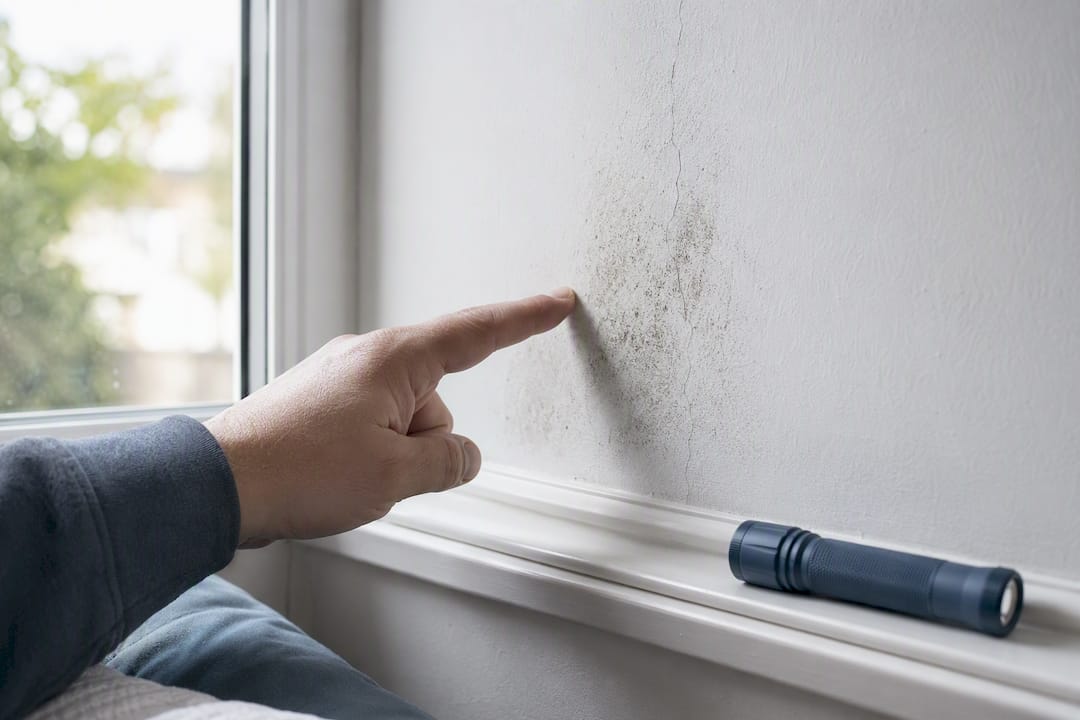
- Living rooms. Look for condensation on windows, mould spots (anything beyond minor surface mould on a reveal is worth photographing), draughts around frames, and whether the room can reach an adequate temperature. Guidance treats persistently cold rooms as an excess cold hazard, one of the more commonly cited Category 1 findings in older housing stock.
- Kitchens. Test extractor fan function, check for gas appliance certification stickers, inspect worktops and flooring for damage that could harbour pests, and confirm there's safe separation between cooking surfaces and combustible materials.
- Bathrooms. Check for mould around sealant and grouting, confirm hot water reaches a safe delivery temperature without scalding risk, test extractor ventilation, and look at flooring for slip hazards.
- Bedrooms. Assess room size against likely occupancy (overcrowding is its own hazard category), check window restrictors on upper floors, and note any damp patches on external walls.
- Stairs and communal areas. Measure handrail height, check banister spacing (gaps wide enough for a child's head are a defined risk), and inspect stair covering for wear that could cause a fall.
- Exterior and structure. Walk the perimeter checking guttering, roof tiles, pointing, and any subsidence indicators like stepped cracks in brickwork.
For photographs, take one overview shot showing the issue in context, plus one close-up that captures detail (a crack's width, a mould patch's spread, a socket's scorch marks). Two images per issue is usually enough. Naming files consistently, room, date, issue, saves hours later when you're building a report.
Mark severity on a simple three-tier scale as you go: immediate (danger to health right now, think exposed wiring or a broken external step), high (needs fixing within weeks, like a failing extractor fan causing mould growth), and routine (general wear that needs monitoring but poses no near-term risk). Immediate and high-severity findings are the ones most likely to correspond to a Category 1 hazard once scored formally, so flag them clearly rather than burying them in a long list.
Pro Tip: Do your room-by-room walk in daylight where possible. Damp patches, hairline cracks, and mould spores are far easier to spot and photograph accurately in natural light than under a landing bulb.
Turning your checklist into audit-ready evidence
An inspection is only as useful as the record it leaves behind. If a council enforcement officer or a tribunal ever asks how you managed a hazard, a scrappy set of notes won't hold up, but a structured file will.
For every deficiency, capture:
- The date and exact location within the property
- A short, factual description (avoid subjective language like "a bit damp")
- The specific baseline indicator it falls short of
- A photo reference and consistent file name
- The assigned priority and proposed remedial action
Build these into an action log with columns for the issue, the date it was reported, a due date for resolution, the contractor instructed, and evidence of completion (an invoice, a photo of the finished repair, or a certificate). This is exactly the kind of proactive record NRLA guidance points to as evidence that reasonable steps were taken to keep a property safe.
Some issues need a professional report attached rather than just your own notes. A Gas Safe certificate for any gas appliance work, a NICEIC-registered electrician's report for wiring concerns, and an asbestos survey for pre-2000 properties showing signs of damaged insulation or textured coatings should all sit in the same file as your inspection record.
How HHSRS scoring actually works
HHSRS scoring isn't a pass or fail test. It calculates a hazard score from two factors: the likelihood of harm occurring over the next 12 months, and the spread of harm, meaning how severe the likely outcome is, from minor injury through to death.
Multiply those two factors together and you get a numerical score that lands in one of two bands:
- Category 1 hazards score above a set threshold and represent a serious and immediate risk. Councils have a duty to take action here under the Housing Act 2004.
- Category 2 hazards score below that threshold. Councils have discretionary powers rather than a duty, though they can still act.
In practice, excess cold from inadequate heating, serious falls risk from unguarded stairs, and severe damp and mould regularly reach Category 1 in older or poorly maintained housing stock. Faulty electrics with visible exposed wiring is another common example.
Where a local authority identifies a Category 1 hazard, it can serve an improvement notice, a prohibition order, or in serious cases prosecute or issue a civil penalty of up to £30,000. That's the sharp end of what a checklist mapped to baseline indicators is designed to help you avoid reaching in the first place.
What to do when your checklist flags a hazard
Finding a hazard during inspection is normal. What matters is how quickly and appropriately you act on it, because that response is what regulators and tribunals actually scrutinise.
- Immediate danger — remove the risk straight away. Cordon off the area, relocate tenants if needed, and arrange emergency repairs the same day.
- High priority — instruct a qualified contractor and fix within a short, defined timeframe, typically days rather than weeks.
- Routine — schedule as part of regular maintenance and monitor for change at the next inspection.
Match the trade to the hazard: Gas Safe registered engineers for anything gas-related, NICEIC-registered electricians for wiring and consumer units, a qualified asbestos surveyor for suspected ACMs, and a structural engineer for anything beyond surface cracking. For itemised, transparent contractor quotes on jobs like carpet and flooring remediation, demanding a written breakdown before work starts protects you from disputes later.
Pro Tip: Photograph the hazard before repair and again after completion. That before-and-after pair is often the single most persuasive piece of evidence in an insurance claim or a council enquiry.
Where to find official HHSRS checklist templates
Don't build a checklist from scratch, and don't rely on a generic template that skips baseline indicators altogether. Three sources cover most landlord needs:
- GOV.UK's operating guidance (Parts 1 and 2) is the primary technical reference, including the full baseline indicators appendix. Best for understanding the underlying standard rather than for quick fieldwork.
- NRLA's landlord checklist maps directly to baseline indicators and works well for single lets and small portfolios doing routine self-inspections.
- DASH Services' landlord checklist condenses baseline indicators into a practical self-assessment template, useful for HMOs where you're inspecting more units more often.
Whichever you start from, adapt it to add a photo reference column and an action-log field. A checklist without those two additions is a snapshot, not evidence.
Making inspections less time-consuming and more reliable
Most landlords already know what a thorough HHSRS inspection looks like. The gap is rarely knowledge, it's consistency: the same checklist used every time, evidence filed the same way, and action logs that don't live in three different notebooks across a portfolio.
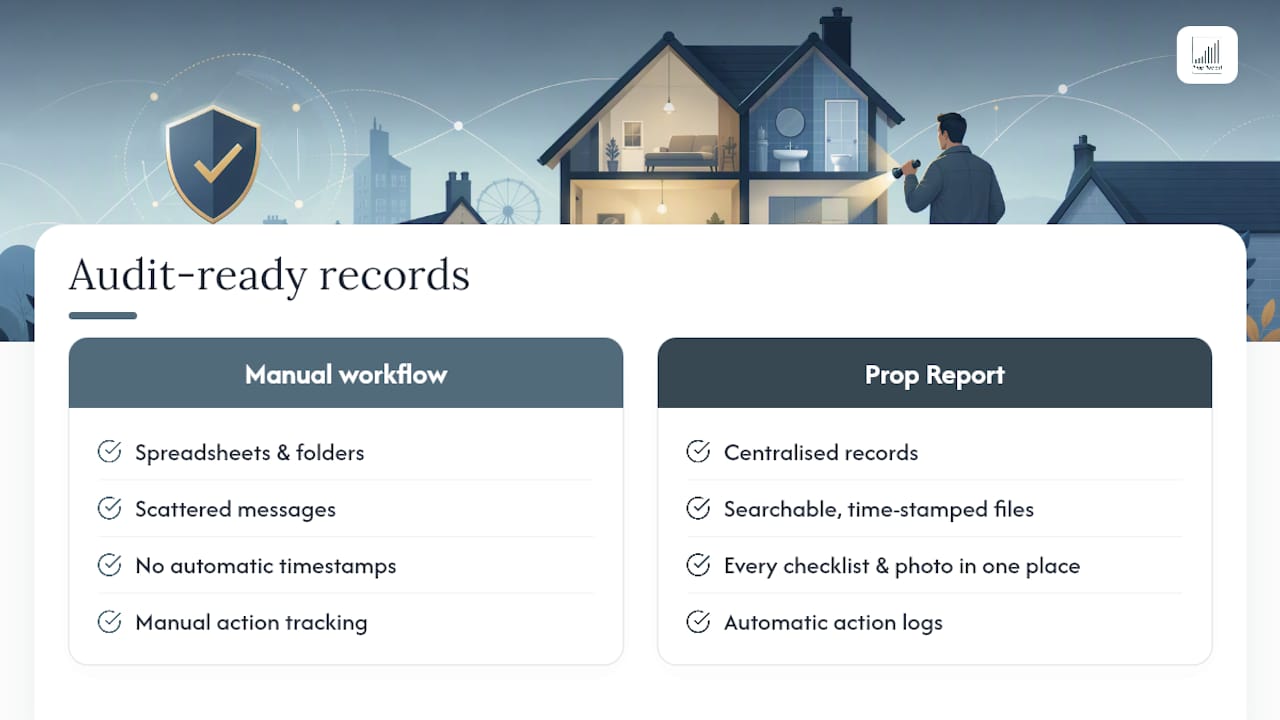
A structured, centralised record cuts the time it takes to respond to a council enquiry from days to minutes, because you're not reconstructing a paper trail under pressure. Pairing an HHSRS walk-through with statutory checks (gas, electrical) and tenant handover in a single visit also avoids sending someone to the same property three times in a month. Tools built for property management, including Prop Report, exist precisely to hold that inspection data, photos, and action logs in one place rather than scattered across email threads.
— James
Keep every inspection audit-ready with Prop Report
A suitable property management platform gives you a faster route to a defensible compliance record than juggling spreadsheets, photo folders, and email chains across a portfolio. Every checklist entry, photo, and remedial action log lives in one place, automatically time-stamped and searchable, so when a council or a tenant raises a query, you're not hunting through old messages to prove what happened and when.
The platform centralises records for landlords and property managers handling multiple properties, with data security behind every file you upload. Action logs update automatically as contractors complete work, cutting the admin that typically eats hours per property each month. If you manage more than a handful of tenancies, that saved time compounds fast.
See how it fits your own portfolio on the Prop Report landlord page, or explore the full platform to see how inspection evidence, statutory checks, and communication sit together in one system.
Sources
Build your checklist from primary guidance rather than second-hand summaries. GOV.UK's operating guidance (Parts 1 and 2) is the definitive technical reference, covering process and the full baseline indicators list. NRLA's landlord and agent guide offers a practical downloadable checklist mapped to those indicators. DASH Services' landlord checklist condenses the same standard into a self-assessment format. For the legal framework behind enforcement, see the Housing Act 2004 directly.
- Housing Health and Safety Rating System (HHSRS): Operating guidance
- HHSRS: Landlord and agent guide | NRLA
- Legislation
FAQ
What are the 21 hazards covered by an HHSRS inspection?
HHSRS assesses 21 hazard categories across four groups: physiological (damp, cold, pollutants), psychological (crowding, noise, security), infection (hygiene, water supply), and safety (falls, fire, electrical, structural collapse). The full list and baseline indicators sit in GOV.UK's operating guidance.
What should be included in an HHSRS inspection checklist?
A complete checklist covers structural condition, damp and mould, heating and ventilation, fire safety, electrical safety, plumbing and sanitary facilities, security, stairs and falls risk, and pest and space assessment, each mapped to a baseline indicator with a photo and priority field.
What is an HHSRS inspection?
An HHSRS inspection is a structured assessment of a rented property against the Housing Health and Safety Rating System, used to identify hazards and score their risk to occupants' health and safety.
What compliance checklists should UK landlords use?
UK landlords should use a checklist that references HHSRS baseline indicators directly, such as the templates published by NRLA or DASH Services, rather than a generic maintenance list with no link to the official standard. Centralising the results in a platform designed for property management keeps that evidence audit-ready across a portfolio.