

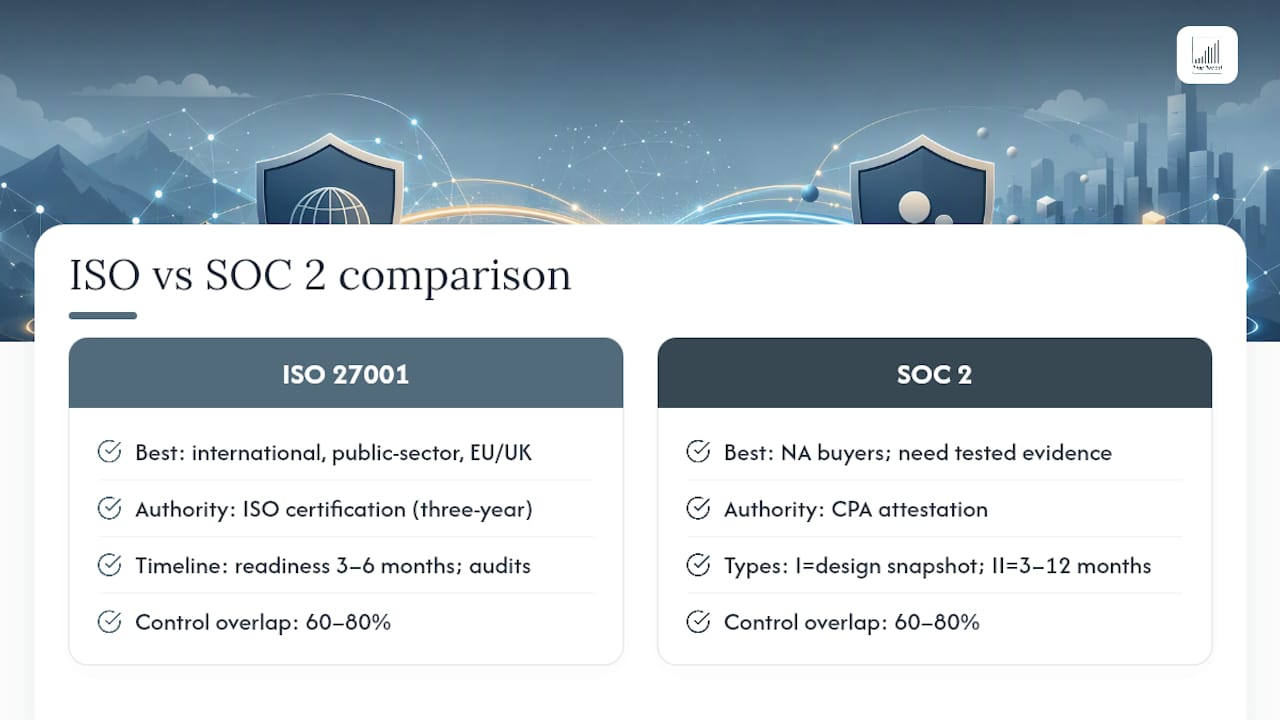
ISO 27001 certifies that your organisation runs a functioning Information Security Management System (ISMS), audited and stamped by an accredited certification body. SOC 2 is different in kind: a licensed CPA firm attests, in a written report, that your controls meet the AICPA's Trust Services Criteria, either at a single point in time (Type I) or across an observation period (Type II).
The procurement heuristic that follows matters more than the technical detail: US and Canadian enterprise buyers commonly request a SOC 2 report, while European, UK, and public-sector procurement teams commonly ask for ISO 27001. Neither preference is universal, but it holds often enough to shape which credential you build first.
- ISO 27001 = a certified management system, valid three years, recognised globally.
- SOC 2 = a CPA-audited report on specific controls, dominant in North American vendor questionnaires.
- The immediate action: ask your buyer which document they will actually accept before you commit budget to either. If you sell into both markets, design one control set mapped to both frameworks from the outset.
Key Takeaways
Buyer geography decides which document unblocks a deal fastest, so map your control programme to both frameworks rather than choosing one in isolation.
| Point | Details |
|---|---|
| Match credential to buyer | US buyers commonly want SOC 2; EU, UK, and public-sector buyers commonly want ISO 27001. |
| Know what each proves | ISO 27001 certifies a management system; SOC 2 attests specific controls via CPA report. |
| Use overlap deliberately | Security-only control overlap runs 60 to 80 percent, so a mapped catalogue avoids duplicate work. |
| Bridge with Type I | A SOC 2 Type I report can satisfy urgent procurement asks while the Type II period runs. |
| Build one programme | A single policy suite and evidence pipeline, mapped to both frameworks, is the efficient long-term path. |
Table of Contents
- ISO 27001 vs SOC 2: what ISO 27001 actually requires
- SOC 2 vs ISO 27001: how the CPA attestation works
- Where ISO 27001 and SOC 2 genuinely overlap
- ISO 27001 vs SOC 2 comparison: the differences that actually decide procurement
- ISO 27001 certification process and SOC 2 attestation timeline
- Choosing ISO 27001, SOC 2, or both
- Building one programme that satisfies both frameworks
- A buyer-driven view on ISO 27001 vs SOC 2
- Frequently asked questions
- Sources
ISO 27001 vs SOC 2: what ISO 27001 actually requires
ISO/IEC 27001:2022 is the international standard for information security management systems, published and maintained by the International Organization for Standardization. It doesn't certify a product or a single control. It certifies that your organisation operates a functioning ISMS, a management system that identifies risks, treats them, and improves continuously.
That distinction trips up a lot of first-time applicants. You're not proving your firewall configuration is correct on audit day. You're proving you have a repeatable process for finding and fixing security gaps, with evidence going back at least one full cycle.
The mandatory ISMS elements are non-negotiable, and auditors check every one:
- A defined scope statement setting the boundaries of what's covered.
- A Statement of Applicability (SoA) explaining which of the 93 Annex A controls apply, and why others don't.
- Documented risk assessment and treatment covering identified threats and chosen mitigations.
- An internal audit programme that reviews the ISMS before the external auditor ever arrives.
- Management review meetings where leadership actually engages with security performance.
- Evidence of continual improvement, not a static policy binder.
Once an accredited certification body signs off, you receive a certificate valid for three years, with annual surveillance audits in between to confirm the ISMS is still alive rather than shelved. The certificate itself, alongside the scope statement and SoA, is what procurement teams actually want to see. International tenders, regulated buyers, and public-sector contracts tend to lean on ISO 27001 precisely because the certificate travels across borders without needing translation or context.
Pro Tip: Don't treat the SoA as paperwork. Buyers who know what they're reading will ask for it directly, and a thin or copy-pasted SoA is one of the fastest ways to lose credibility with a security-literate procurement team.
SOC 2 vs ISO 27001: how the CPA attestation works
SOC 2 isn't a certification at all, technically speaking, it's an attestation. The AICPA governs the framework, and a licensed CPA firm, not an accreditation body, performs the audit and issues the report.
The audit runs against the Trust Services Criteria: Security is mandatory for every SOC 2 engagement, while Availability, Processing Integrity, Confidentiality, and Privacy are optional additions depending on what your service actually does. A company handling payment processing might add Processing Integrity. A company storing sensitive personal data might add Confidentiality or Privacy.
The Type I versus Type II distinction is the one every buyer asks about first:
- Type I attests that controls are designed appropriately at a single point in time. It's faster to produce, and it answers the question "do you have the right controls on paper?"
- Type II attests that those controls actually operated effectively over an observation period, commonly three to twelve months. It answers the harder question: "did the controls work, consistently, when nobody was watching?"
Unlike ISO 27001's certificate, a SOC 2 report is a dense, multi-page document containing the auditor's opinion and detailed test results, typically shared under NDA and read closely by security and vendor-risk teams. That granularity is exactly why US-centric buyers and technically sophisticated security teams tend to prefer it: they get to see the actual test evidence, not just a pass/fail stamp.
Where ISO 27001 and SOC 2 genuinely overlap
The two frameworks share more substance than most comparisons admit. Both demand formal risk assessment, and both build around a similar set of technical and procedural controls: access management, change management, vulnerability management, incident response, vendor risk management, logging and monitoring, and encryption.
Both also rely on independent third-party evaluation to make that trust portable. An accredited certification body does the work for ISO 27001; a CPA firm does it for SOC 2. Either way, the point is the same: a buyer doesn't have to take your word for it.
Control overlap between ISO 27001's Annex A and SOC 2's Trust Services Criteria commonly sits in the 60 to 80 percent range for Security-only mappings, with detailed crosswalks putting Security-only overlap as high as 75 to 80 percent. Adding Trust Services Categories beyond Security reduces that overlap because those categories lack direct ISO equivalents.
- If your SOC 2 scope stays Security-only, expect most of your ISO 27001 evidence to double up directly.
- Add Availability, Processing Integrity, Confidentiality, or Privacy, and you'll need extra controls with no ISO counterpart.
- A single control catalogue and evidence pipeline, mapped once, can satisfy both audits without duplicating the underlying work.
ISO 27001 vs SOC 2 comparison: the differences that actually decide procurement
Here's where the two frameworks pull apart, and where most confusion actually starts.
| Dimension | ISO 27001 | SOC 2 |
|---|---|---|
| Scope | Organisation-wide ISMS | System or service-level |
| Output type | Third-party certificate | CPA attestation report |
| Issued by | Accredited certification body | Licensed CPA firm |
| Market recognition | Global, strong in EU/UK/APAC and public sector | Dominant in North America |
| Evidence format | Certificate + Statement of Applicability + scope | Detailed multi-page report with test results |
| Validity/cycle | Three years, annual surveillance audits | Type I is point-in-time; Type II covers an observation period |
| Structural requirement | Mandatory internal audit and management review | Mandatory system description and continuous evidence |
The scope difference matters more than it looks on paper. ISO 27001 certifies your whole management system: policies, governance, risk treatment, the works. SOC 2 certifies specific controls tied to a defined system or service, which is why two products from the same company can carry entirely separate SOC 2 reports while sharing one ISO certificate.
The structural requirements diverge too. ISO 27001 demands a formal Statement of Applicability, an internal audit programme, and documented management review cycles that SOC 2 simply doesn't require. SOC 2, in turn, demands a detailed system description and continuous operating evidence across the observation window, something ISO's point-in-time certification audit doesn't test in the same way.
Neither framework is objectively harder. They're answering different questions for different audiences:
- ISO 27001 answers: "Does this organisation manage security as an ongoing discipline?"
- SOC 2 answers: "Did these specific controls actually work, with evidence, over this period?"
Pro Tip: When a deal is time-sensitive, a SOC 2 Type I can hand procurement something concrete within weeks, while your Type II observation period runs in the background. ISO 27001's certificate, once earned, gives you three years of runway that most procurement teams accept without re-litigating annually.
ISO 27001 certification process and SOC 2 attestation timeline
The paths to each credential look superficially similar and behave quite differently in practice.
- ISO 27001 readiness. Build or mature the ISMS: define scope, run risk assessments, draft the SoA, and generate at least one cycle of internal audit and management review evidence.
- Stage 1 audit. The certification body reviews documentation to confirm the ISMS is designed correctly.
- Stage 2 audit. The certification body tests whether the ISMS actually operates as documented.
- Certification and surveillance. A three-year certificate is issued, with annual surveillance audits in between. First-time readiness commonly takes three to six months depending on existing maturity, plus audit scheduling.
SOC 2 runs on a different clock:
- Scoping and system description. Define which Trust Services Categories apply and document the system being assessed.
- Readiness assessment. Identify gaps against the criteria before the formal audit window opens.
- Type I report (optional). A point-in-time snapshot, useful as a near-term deliverable.
- Type II observation period. Commonly three to twelve months of continuous evidence collection, followed by auditor sampling and report issuance. Total elapsed time often runs four and a half to nine months or longer.
Cost drivers are similar across both: readiness consulting, auditor fees, internal labour, GRC tooling, and evidence preparation. The most common pitfalls are avoidable: an incomplete SoA, an evidence pipeline that stops updating after the first audit, or an internal audit programme that exists on paper but never actually ran. Building a mapped, joint programme from day one typically avoids duplicating this work twice.
Choosing ISO 27001, SOC 2, or both
Run through this checklist before committing budget:
- Where is your primary buyer based? North American pipelines lean SOC 2; EU, UK, and APAC pipelines lean ISO 27001.
- What's your customer profile? Public-sector and regulated-industry buyers frequently mandate ISO 27001 by name in tender documents.
- What does your procurement questionnaire actually ask for? Read the exact wording. Some ask for "SOC 2 Type II or equivalent," which ISO 27001 usually satisfies; others name ISO 27001 specifically.
- What's your product scope? A single service with a defined boundary suits SOC 2's system-level report; an organisation-wide security posture suits ISO's ISMS.
- How urgent is the deal? SOC 2 Type I can be produced faster than an ISO certification cycle if you need something in procurement's hands within weeks.
Pick SOC 2 first if your pipeline is US-heavy, you need tested evidence quickly, or you're operating inside platform ecosystems (cloud marketplaces, investor due diligence) that expect a SOC report by default.
Pick ISO 27001 first if you're chasing international tenders, public-sector contracts, or you want a credential that survives cross-border scrutiny without a US CPA firm's name attached to it. Vanta's comparison work notes that ISO 27001's continuous-improvement loop also makes it easier to bolt on related standards later, ISO 27701 for privacy or ISO 22301 for business continuity, because the ISMS machinery already exists.
Pro Tip: If your commercial roadmap includes both markets within eighteen months, don't sequence the two frameworks as separate projects. Design the control set once, mapped to both, and you'll pursue them concurrently rather than rebuilding evidence twice.
Building one programme that satisfies both frameworks
Running ISO 27001 and SOC 2 as a single programme, rather than two separate projects, is the efficient path once you know both are coming. The pattern looks consistent across organisations that do this well: one policy suite, one control catalogue mapped to Annex A and the Trust Services Criteria simultaneously, a GRC platform tagging evidence against both frameworks, and audit calendars coordinated so evidence collection doesn't happen twice.

Overlap is densest in access control, vulnerability management, incident response, logging, and vendor management. Divergence shows up where each framework has a structural requirement the other doesn't: ISO's SoA and management-review artefacts, and SOC 2's system description and observation-period evidence.
| Control Area | Annex A Reference | Trust Services Criteria |
|---|---|---|
| Access management | A.5 (access control) | Common Criteria |
| Vulnerability management | A.12 (technical vulnerability management) | Common Criteria (system operations) |
| Incident response | A.5 to A.5.28 | CC7 (system operations) |
| Vendor risk management | A.5 (access control) | Common Criteria (risk mitigation) |
The AICPA publishes a mapping spreadsheet linking Trust Services Criteria directly to Annex A controls, which is a genuinely useful starting point rather than building a crosswalk from scratch. Assign clear governance ownership per control area, agree evidence-tagging conventions early, and coordinate audit windows so your internal team isn't collecting the same logs twice in the same quarter.
Practitioner advice: ask the buyer, don't guess
The consistent recommendation from practitioners across this space is blunt: ask your procurement or vendor-risk contact which document they'll actually accept before you decide anything internally. Guessing wastes months.
For organisations selling across North America and Europe simultaneously, implementing one unified security programme that can produce either deliverable is the most efficient route, and it's the approach Propreport has taken with its own ISO 27001 certification, built to satisfy the security expectations of both landlord customers and property-management enterprises regardless of which document a given deal requires.
Pro Tip: If a North American deal stalls waiting on a full SOC 2 Type II, a Type I report can bridge that gap while the observation period completes, without forcing you to abandon the longer-term ISO 27001 build running in parallel.
A buyer-driven view on ISO 27001 vs SOC 2
Most comparisons treat this as a technical question. It isn't. It's a sales question wearing a compliance costume, and the moment you accept that, the decision gets easier, not harder.
The conventional advice, "pick whichever framework matches your maturity level", misses the point entirely. Maturity doesn't close deals. A specific document sitting in a specific procurement folder closes deals. That's why the first move should always be a direct question to your buyer, not an internal audit of your own readiness.
Where I'd push back hardest: treating ISO 27001 and SOC 2 as sequential projects wastes real money, given how much of the underlying control work is shared. If you already know both markets are on your roadmap, the parallel-run approach isn't the cautious option. It's the cheaper one. Propreport built its own ISO 27001 certification with exactly this buyer-first logic in mind, and it's the same logic worth applying before you sign a single readiness-consulting invoice.
Frequently asked questions
Is ISO 27001 or SOC 2 better for a software vendor? Neither is universally better. ISO 27001 suits vendors targeting international, public-sector, or EU/UK buyers; SOC 2 suits vendors with a North American-heavy customer base needing detailed, tested control evidence.
Can one company hold both ISO 27001 and SOC 2? Yes, and it's increasingly common. Because Security-only control overlap between the two frameworks runs 60 to 80 percent, a mapped programme lets you produce both outputs without duplicating most of the underlying work.
What's the real difference between SOC 2 Type I and Type II? Type I confirms your controls are designed correctly at one moment. Type II confirms those same controls actually operated effectively across an observation period, commonly three to twelve months, making it the more rigorous of the two.
Does SOC 2 certification exist, or is it always called an attestation? Technically it's an attestation, not a certification. A CPA firm issues a report describing its findings rather than an accreditation body issuing a certificate, which is why "SOC 2 certified" is a common but technically imprecise phrase.
How long does ISO 27001 certification typically take for a new applicant? Readiness commonly takes three to six months depending on existing security maturity, followed by a Stage 1 and Stage 2 audit before the three-year certificate is issued.
Sources
For implementation detail beyond this comparison, go straight to the source material rather than secondary summaries:
- ISO 27001 standard page
- SOC 2 ISO 27001 joint certification — crosswalk guide
- A-LIGN article on SOC 2 timing