
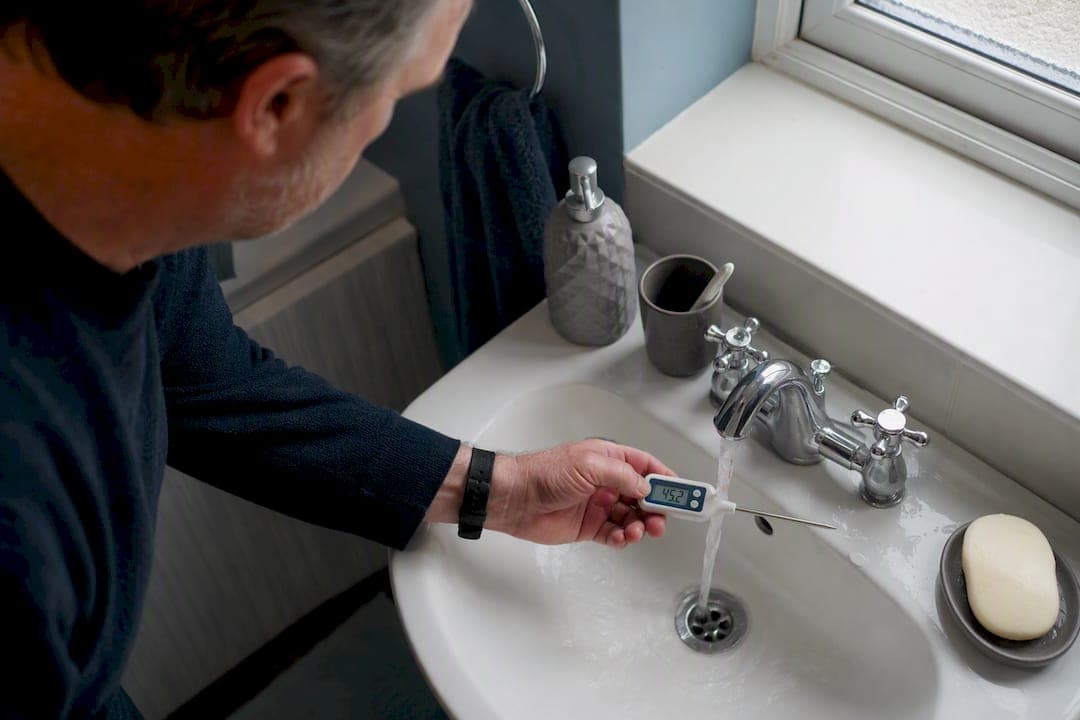
Yes. Every UK landlord has a legal duty to carry out a "suitable and sufficient" legionella risk assessment on their rented property and to control any risk found. There is usually no formal "legionella certificate" for a standard domestic let, but a documented assessment and a record of the controls you've put in place are expected.
Three things you can do today:
- Check the temperature. Run a hot tap for a minute; delivered water should reach around 50°C.
- Flush little-used outlets. Run any shower or tap that hasn't been used in a week or more until it runs clear and warm.
- Write it down. A dated note of what you checked and found is your evidence trail.
If your property has a water tank, a communal system, or you simply aren't confident assessing it yourself, bring in a competent professional rather than guessing.
Pro Tip: Keep a phone photo of the thermometer reading alongside your written note. It costs nothing and gives you a timestamped record if a tenant or inspector ever asks for evidence.
Key Takeaways
UK landlords must carry out a suitable and sufficient legionella risk assessment, implement proportionate controls, and keep a dated record proving those controls were actually followed.
| Point | Details |
|---|---|
| Legal duty is clear | HSWA requires a documented risk assessment and controls; no formal certificate exists for most domestic lets. |
| Self-assessment is usually fine | Simple single-let systems can be assessed by a competent landlord; complex or tank-fed systems need a specialist. |
| Temperatures are the main control | Hot storage at 60°C, delivered hot water near 50°C, cold water below 20°C, checked and logged regularly. |
| Records matter more than the plan | Monitoring logs proving checks happened protect you far more than a one-off written assessment. |
| Vacant properties need re-checks | Flush outlets, run showers, and verify temperatures before re-letting after any extended void. |
| Centralised tools ease the admin | Platforms like Prop Report help schedule checks and store logs, though they don't replace the assessment itself. |
Table of Contents
- What UK law actually requires (HSWA, ACOP L8 and HSG274)
- Who can carry out the assessment?
- Step-by-step: what a basic domestic assessment should cover
- Control measures and how often to check them
- What to record and when to review it
- Getting a property ready after it's stood empty
- Testing versus monitoring: which do you actually need?
- How much does an assessment cost, and how long does it take?
- Keeping a small portfolio compliant without the admin headache
- An easier way to keep your legionella records straight
- Where to find official guidance and templates
- Sources
What UK law actually requires (HSWA, ACOP L8 and HSG274)
The Health and Safety at Work etc. Act 1974 places the legal duty on whoever controls the premises, which for a rented property is normally the landlord or managing agent. The practical detail sits in the Approved Code of Practice L8 and its companion technical guidance, HSG274, both published by the Health and Safety Executive (HSE). Together they explain what "suitable and sufficient" looks like in practice.
For most domestic lets, HSE guidance confirms there's no legal requirement for a formal legionella test certificate. What is required is a documented assessment, sensible controls, and evidence that you've actually followed them. That evidence matters more than most landlords realise.
- A written record of when the assessment was done and by whom.
- Monitoring logs showing temperature checks and flushing actually happened.
- A note of any remedial action taken.
Landlords who skip the paperwork but do the checks anyway still leave themselves exposed. Courts and HSE inspectors look for a working record, not a one-off assessment gathering dust in a drawer.
Who can carry out the assessment?
You don't need a specific qualification to assess a simple domestic system. HSE guidance describes a "competent person" as someone with the knowledge, experience, and resources to identify legionella risks and put suitable controls in place, and for a standard rented flat or house, many landlords fit that description themselves.
Straightforward systems, one boiler, standard taps and showers, no water storage tank, are generally within a landlord's own competence to assess. Communal or tank-fed systems, calorifiers, or properties with vulnerable occupants (elderly tenants, those who are immunosuppressed) usually call for a specialist.
Before attempting it yourself, ask:
- Do I understand where water might sit stagnant in this property?
- Can I identify every outlet, including outside taps and rarely used showers?
- Do I know how to take and record an accurate temperature reading?
Pro Tip: If you manage more than a handful of properties, it's often cheaper over time to train yourself properly once than to pay a specialist for every routine reassessment.
Step-by-step: what a basic domestic assessment should cover
A suitable and sufficient assessment follows a logical sequence, not a tick-box exercise.
- Map the system. Note every tank, calorifier, showerhead, tap, and any fitting that produces a fine spray, since aerosols are how legionella actually spreads.
- Identify who's exposed. Consider occupant age, health, and how often the property is used.
- Spot stagnation risks. Look for dead legs (redundant pipe sections), rarely used outlets, and any point where water sits still for long periods.
- Judge the risk level. Most single-let domestic properties turn out low risk. Where risk exists, a written scheme of control and a monitoring schedule are the response, per NRLA guidance for landlords.
- Act immediately on anything obvious. Flush stagnant outlets, check temperatures, and remove any redundant pipework you find.
- Photograph the system layout as you go; it saves time on the next review.
- Keep a simple diagram, even hand-drawn, showing outlets and any dead legs.
Control measures and how often to check them
Temperature is the main lever landlords have. HSG274 Part 2 sets out starting points: hot water should be stored at 60°C, delivered at taps at around 50°C within a minute, and cold water should stay below 20°C. Legionella bacteria multiply fastest between roughly 20°C and 45°C, which is why keeping water outside that band is the core control.
Monitoring frequencies from HSG274 Part 2 are starting points that your own risk assessment should adjust to fit the property. Reasonable defaults for a domestic let include:
- Weekly: flush any shower or tap not used in the previous seven days.
- Monthly: check sentinel outlet temperatures (the first and last taps on the system).
- Quarterly: clean and descale shower heads.
- Six-monthly: inspect any cold water storage tank.
- Annually: check calorifiers and the wider system for scale or corrosion.
Treat this as a rolling programme rather than a single event, and log every check with a date. Water sampling sits outside this routine entirely; it isn't required for typical domestic lets unless controls have failed or a specific concern has been raised.
What to record and when to review it
Your written scheme of control doesn't need to be lengthy, but it does need four things: who carried out the assessment, the significant findings, the control measures agreed, and a running monitoring log with dates.
Reassess whenever something material changes: a new tenant with health vulnerabilities moves in, the property has stood empty for weeks, monitoring shows a reading outside your control limits, or there's any suspected case of illness linked to the water system.
- Match your review date to another scheduled visit (gas safety check, routine inspection) to cut the number of separate trips to the property.
Pro Tip: A shared spreadsheet or app that timestamps each entry beats a paper logbook, because it's harder to lose and easier to produce quickly if you're ever asked for it.
Getting a property ready after it's stood empty
Stagnant water is the single biggest risk driver, and the UKHSA legionella factsheet is clear that dormant systems need attention before re-letting.
- Flush every outlet, hot and cold, until the water runs clear.
- Run all showers for several minutes, ideally with the head removed to limit aerosol exposure.
- Check sentinel temperatures once flushing is complete.
- Inspect any storage tank if the property has one.
If the property was empty for an extended period or temperatures come back wrong, professional disinfection may be the sensible next step.
Testing versus monitoring: which do you actually need?
Temperature monitoring is your everyday compliance evidence; it's simple, cheap, and shows the system is under control. Microbiological sampling is a snapshot, used when monitoring flags a problem or an investigation is needed, not as routine practice.
- If you do commission sampling, use a UKAS-accredited laboratory and ask for a clear written report.
- A lab "test certificate" is not the same as an ongoing monitoring record, and it doesn't replace one.
How much does an assessment cost, and how long does it take?
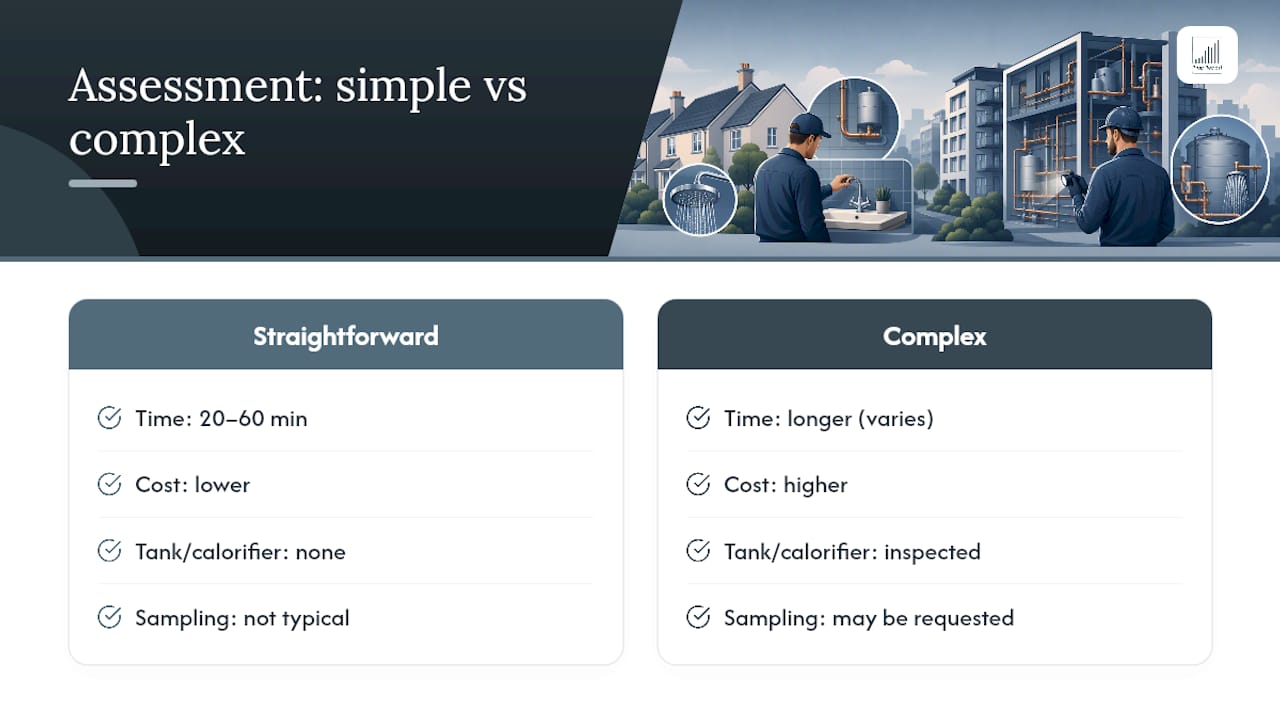
A straightforward domestic assessment typically takes 20 to 60 minutes. Costs rise with tank or calorifier inspections, any sampling requested, and remedial plumbing. Ask for a written quote, check the assessor's competence, and request UKAS lab evidence if sampling is proposed.
Keeping a small portfolio compliant without the admin headache
Running legionella checks alongside your gas safety visits and routine inspections turns three separate admin tasks into one workflow, which is how most experienced landlords actually manage it in practice. The harder part isn't doing the check, it's proving you did it six months later when a tenant query or an inspection lands on your desk.
Centralising logs and reminders in one place, rather than across notebooks, phone photos, and email threads, is where tools like Prop Report earn their keep for landlords with more than one or two properties.
An easier way to keep your legionella records straight
Prop Report gives you one place to schedule sentinel temperature checks, log the results, and store every monitoring record against the right property, so nothing depends on you remembering which spreadsheet you last updated.
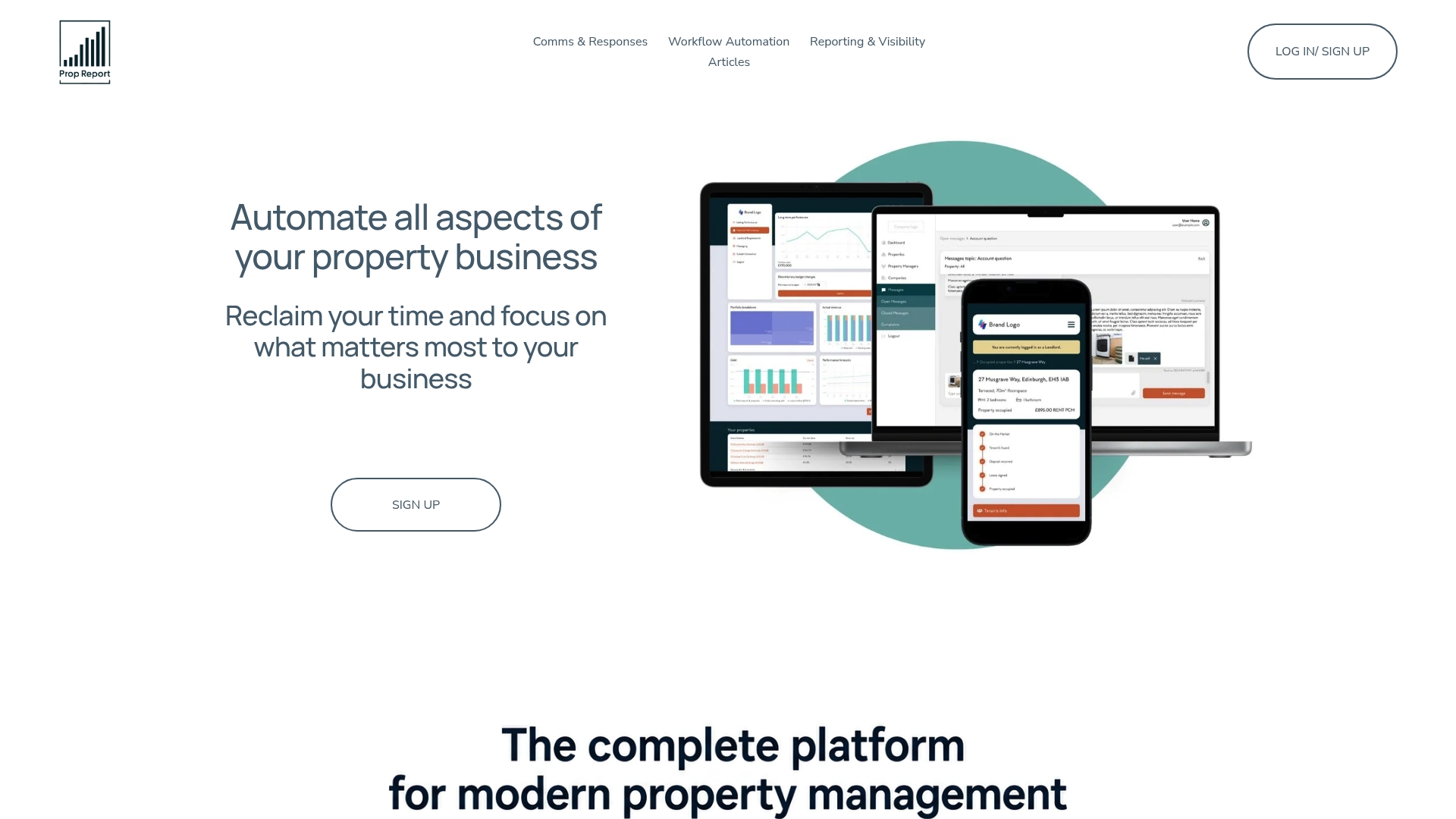
To be clear: software doesn't do the risk assessment for you. You, or a competent professional, still need to carry out the suitable and sufficient assessment and decide the controls. What automation removes is the part landlords actually get caught on, missed reminders and scattered evidence, by turning your monitoring schedule into recurring tasks with a timestamped log attached to each property. If you're managing several lets and the paper trail is starting to feel unmanageable, take a look at Prop Report's property management platform and book a demo to see how it fits your current routine.
Where to find official guidance and templates
- HSE landlord guidance covers legal duties and links to ACOP L8 and HSG274.
- NRLA resources offer templates and checklists for members.
- UKHSA's factsheet explains health risks and vacancy precautions.
- For sampling, use a UKAS-accredited lab and reference BS 8580-1:2019 for best-practice assessment methodology.
Sources
- Legionella and landlords' responsibilities - HSE
- Legionella Risk Assessment for Landlords | NRLA
- Legionella monitoring schedule: what to check and when - LegionellaCheck
- UKHSA legionella factsheet - FWE
Recommended
- Call Model 4 - Landlord property rentals | Streamline Landlord Marketing - Learn More — Prop Report
- Call Model 2 - Tenant not maintenance or applications | Enhance Tenant Communication Today — Prop Report
- Coco Property Call Model 4 | Streamline Repairs Now — Enhance Tenant Communication — Prop Report
- Modern Slavery Statement | Ensure Ethical Practices — Prop Report