
Track three phases: acknowledgement, dispatch, and resolution. Acknowledge tenant requests within 15 to 60 minutes during business hours, dispatch emergency callouts within a couple of hours, and expect routine work orders to reach a median resolution typically around two weeks. These are starting points, not fixed rules; tighten them for critical sites and life safety issues, and loosen them for after-hours cover, capital works, or scarce trades.
TL;DR:
- Emergency dispatch should occur within two hours, with hospitals and data centers tightening this to under one hour regardless of generic benchmarks.
- Median resolution times vary by task, with plumbing and HVAC usually resolving in about seven to ten days, while roofing can take up to three weeks.
- Tracking both median and 90th-percentile repair times is essential to identify operational slowdowns and improve tenant satisfaction.
- Automated timestamped reporting systems are crucial for accurately measuring and improving maintenance response performance.
- Focusing on acknowledgment speed and after-hours response is typically more effective than solely trying to accelerate repair times.
Table of Contents
- Maintenance response time benchmarks at a glance
- How do you calculate maintenance response time correctly?
- Benchmarks by severity and trade: what "normal" looks like
- Writing SLA wording and building the right KPI dashboard
- Practical steps to improve maintenance response time
- How Prop Report customers put these benchmarks into practice
- Why measuring the right metric matters more than measuring fast
- Turning these benchmarks into a working dashboard
- Sources
Maintenance response time benchmarks at a glance
Every serious maintenance operation grades requests by severity before setting a target. Treat the tiers below as a working framework you can adapt to your portfolio, not a universal standard, since target ranges genuinely vary by asset type and region.
| Priority tier | Acknowledge | Dispatch | Typical resolution |
|---|---|---|---|
| P1 Emergency | Immediate | Under 2 hours | several hours to a day, depending on scope |
| P2 Urgent | 30–60 minutes | 4–24 hours | 24 hours–5 days |
| P3 Routine | Within 1 business hour | Scheduled within 24 hours | 5–7 business days |
| P4 Scheduled/capital | Within a couple of hours | As planned | up to a month |
These figures echo the acknowledgement and dispatch benchmarks reported by Veyra Group, which sets emergency dispatch at under two hours and routine completion around 5 to 7 business days, alongside the four-tier structure used in facility SLA templates from Oxmaint.
A few adjustments matter in practice:
- Hospitals, data centres, and cold storage sites should tighten P1 dispatch to well under an hour, regardless of what a generic benchmark suggests.
- Capital projects and anything dependent on weather or specialist parts should sit in P4, where a 30-day window is realistic rather than lax.
- Anything genuinely life-threatening (gas, fire, structural failure) belongs above P1 in your own escalation policy, with no negotiable target at all.
How do you calculate maintenance response time correctly?
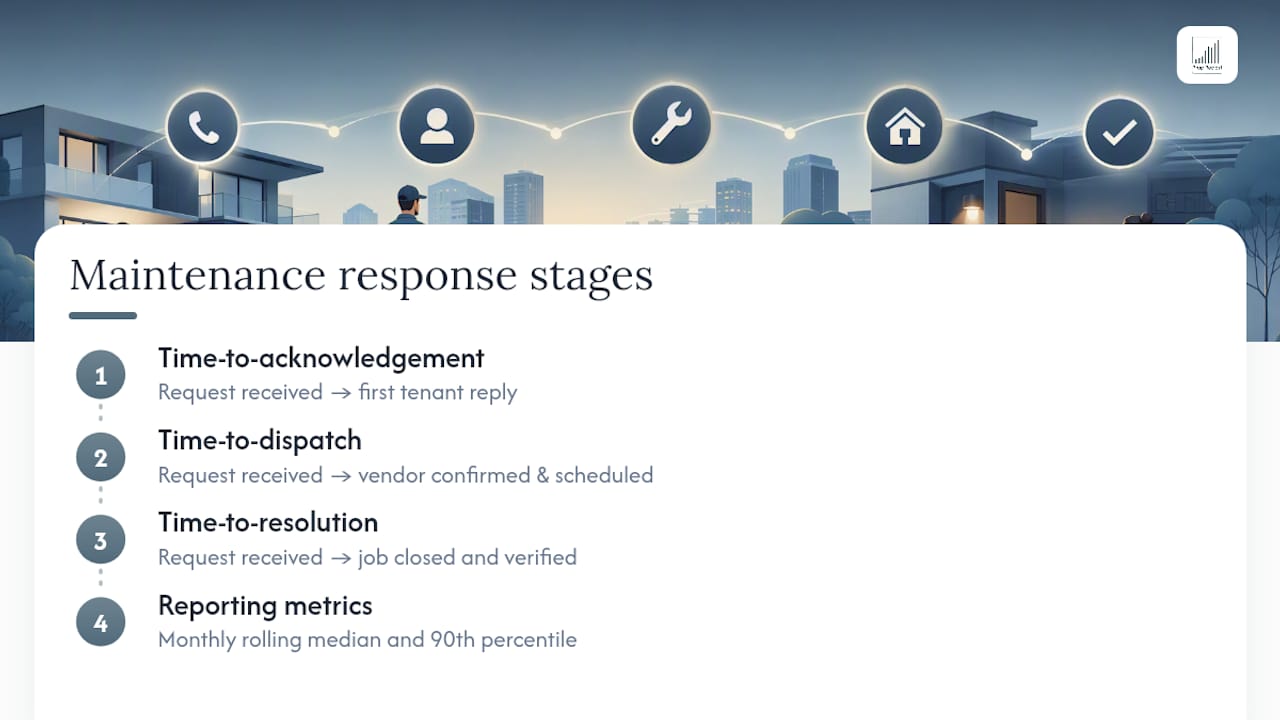
Three timestamps define the whole picture: time-to-acknowledgement (request received to first tenant-facing reply), time-to-dispatch (request received to a vendor confirmed and scheduled), and time-to-resolution (request received to job closed and verified). Without all three, you cannot tell whether a slow outcome was a communication failure or a genuine repair delay.
Mean Time to Repair follows a simple formula: total repair time divided by number of repairs in the period. Report it alongside availability where relevant, following the definitions set out in the SMRP and EN 15341 maintenance KPI reference, which recommends labelling any external number as either directly sourced or commonly cited.
Statistic to remember: across more than 193,000 work orders analysed by Hemlane, the median resolution time was around two weeks, while the arithmetic average was much higher due to outliers. A handful of multi-month outliers drag the mean far above what most tenants actually experience.
Report both the median and the 90th percentile every month, on a rolling 30-day basis. The median tells tenants what to expect; the 90th percentile tells you where your operation actually breaks.
Benchmarks by severity and trade: what "normal" looks like
Top-line targets only become useful once you split them by trade and by whether the clock is running during business hours or overnight. OpsPilot's benchmark data puts industry-average initial contact ranges from a few to several hours, with high performers replying within an hour, and industry-average time-to-dispatch taking half a day to a full day, with best performers under four hours.
Category medians vary more than most dashboards admit. In the Hemlane dataset, plumbing and HVAC repairs typically resolve in about a week to ten days, both faster than the 13.1-day portfolio-wide median. Locks and access issues typically resolve same-day given their safety implications, while roofing often stretches toward the top of the P4 window because of weather dependency and scaffolding access.
Practical ranges worth adopting by category:
- Locks and security: same-day resolution expected; treat any delay past 4 hours as an escalation.
- Plumbing (leaks, blockages): median around 7–10 days for non-emergency jobs; burst pipes belong in P1.
- HVAC: median around 7–10 days; total system failure in occupied space escalates to P2 minimum.
- Roofing and structural: realistic median 10–21 days, extending further where weather windows apply.
Split every one of these by business-hours versus after-hours performance. A common finding across maintenance operations is that teams comfortably hit daytime targets and then quietly miss them overnight and at weekends, which is exactly where vendor scorecards and category-level 90th-percentile tracking earn their keep.
Writing SLA wording and building the right KPI dashboard
Turning benchmarks into contract language means being specific about the clock, the evidence, and the consequence. A workable clause reads something like: "P2 requests will be acknowledged within 60 minutes and dispatched within 24 hours during business hours, with resolution targeted within 5 business days. Compliance is measured against timestamped records of receipt, acknowledgement, dispatch, and closure."
SLA compliance itself has a standard formula, drawn from performance-measurement methodology used in regulated service contracts: divide the number of events meeting the target by total events in the period, then multiply by 100, as set out in the DCC performance measurement methodology. Every timestamp needs to be immutable to survive an audit or a dispute.
Track this minimum KPI set every month:
- Median time-to-acknowledgement
- Median time-to-dispatch
- Median time-to-resolution
- 90th-percentile time-to-resolution
- SLA compliance rate (%)
- First-time fix rate (%)
Slice each figure by property, trade, vendor, and business-hours versus after-hours, and report both a monthly snapshot and a rolling 30-day trend.
Pro Tip: Set an automated alert on your 90th-percentile figure rather than the median. The median can look healthy for months while a widening tail of missed jobs quietly erodes tenant trust.
Practical steps to improve maintenance response time
Four levers move these numbers faster than adding headcount. Consolidated intake removes the guesswork of requests arriving by phone, email, and text in parallel. Automated triage classifies severity the moment a request lands, so P1 issues never sit in a general queue. Pre-approved dispatch rules let routine jobs go straight to a vendor without a manager approving each one individually. Curated emergency vendor panels mean a P1 call at 2am has somewhere to go.
After-hours performance needs its own fix, not an extension of daytime process:
- Auto-acknowledge every after-hours request immediately, even before a human responds.
- Build exception handling so genuine emergencies bypass the standard queue.
- Rotate a dedicated emergency vendor panel rather than relying on whoever answers the phone.
Pro Tip: The fastest wins usually come from fixing the acknowledgement gap, not the repair itself. Tenants forgive a slow repair far more readily than silence.
How Prop Report customers put these benchmarks into practice
Property teams running these benchmarks need one thing above all: a single system logging every timestamp automatically, rather than reconstructing them from email threads after the fact. Prop Report's platform centralises intake, applies automated acknowledgement, and produces timestamped reporting that maps directly onto the KPI set above.
In practice, that means:
- Central intake replacing scattered phone, email, and WhatsApp threads.
- Automated acknowledgement firing the moment a request lands, day or night.
- Timestamped reports feeding directly into CRM and vendor workflows, backed by ISO 27001-certified data handling.
Why measuring the right metric matters more than measuring fast
Speed alone is a hollow metric if you're measuring the wrong phase. A property team that nails acknowledgement but drags on resolution keeps tenants informed and patient; one that resolves quickly but never acknowledges leaves tenants assuming nobody is listening. Owners care about the median because it reflects what most tenants experience, but the 90th percentile is where renewals are won or lost.
— James
Turning these benchmarks into a working dashboard
Reading a benchmark table is one thing; producing the timestamped evidence behind it every month is another. Propreport is the practical route to that evidence: instead of reconstructing acknowledgement and dispatch times from scattered inboxes, requests flow through one centralised communications hub, acknowledged automatically and logged against the KPI set above without a manager chasing the data by hand.
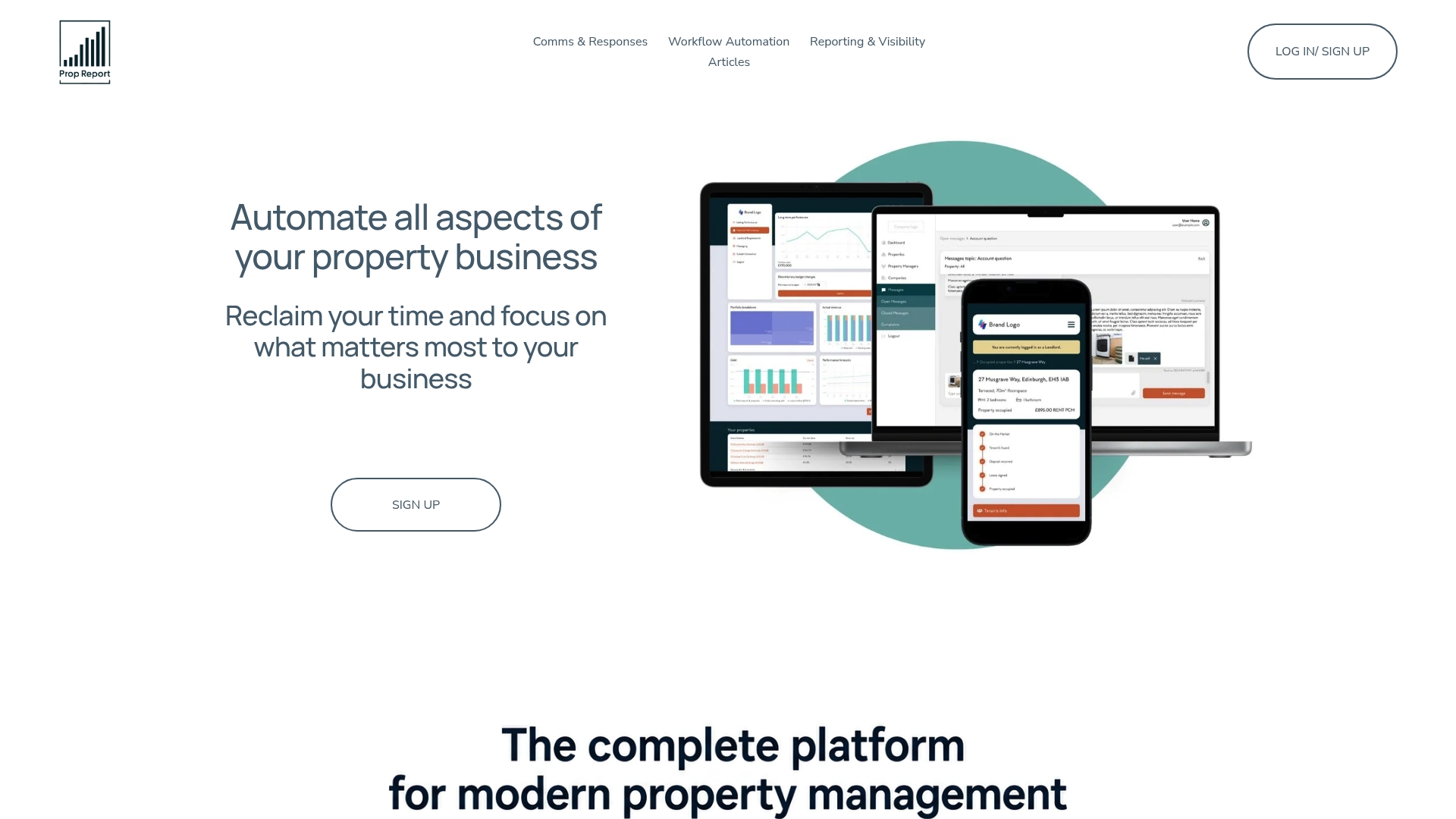
The owner reporting dashboard turns those timestamps into the median and 90th-percentile figures owners actually want to see, backed by ISO 27001-certified data handling rather than a spreadsheet nobody fully trusts. For a property manager already juggling vendor coordination and tenant expectations, that's the difference between chasing benchmarks and simply meeting them.
If your current setup can't tell you your own 90th-percentile resolution time on demand, book a demo of Prop Report and see what a properly instrumented maintenance workflow looks like.
Sources
- Maintenance Response Time Benchmarks (2026): What to Measure and Why | Veyra Group
- Maintenance Request Response Time Benchmarks: What's Normal? | OpsPilot
- Facility management SLA template and KPI benchmarks | Oxmaint