

To avoid civil penalties, carry out a right to rent check on every adult occupier before the tenancy starts and retain dated, immutable evidence. This is the single action that creates your statutory excuse, the legal defence that protects you if a tenant turns out not to have permission to live in the UK.
You have four routes available: the Home Office share code service, manual document checks, a certified digital identity service provider (IDSP), or the Landlord Checking Service (LCS) when a tenant has neither documents nor a share code.
- Check every adult who will live there, not just those named on the tenancy agreement.
- Complete the check before the tenancy starts, not after move-in.
- Diarise follow-up checks for anyone with time-limited permission to be in the UK.
Pro Tip: Correct checks don't just tick a box. They're the only thing standing between you and a civil penalty if a tenant's immigration status turns out to be invalid.
Key Takeaways
A statutory excuse depends on timely checks, immutable dated evidence, and disciplined follow-up scheduling, not just a correct initial document inspection.
| Point | Details |
|---|---|
| Check before occupation | Run the right to rent check on every adult occupier before the tenancy starts, never after move-in. |
| Match the method to the tenant | Use manual documents, a share code, a certified IDSP, or the LCS depending on what the tenant can provide. |
| Diarise the real expiry date | Schedule follow-ups against the later of permission expiry or 12 months after the initial check. |
| Store evidence securely | Retain unalterable copies for the tenancy's duration plus 12 months, then destroy them securely. |
| Automate to avoid gaps | Prop Report centralises check evidence and automates follow-up reminders under ISO 27001-certified security. |
Table of Contents
- Who needs to run right to rent checks, and on which tenancies
- When to check, and how to schedule follow-ups
- How to run the check: documents, share codes, IDSPs and the LCS
- What records prove you did the check properly
- How to avoid discrimination while checking tenants
- Practical fixes that actually reduce compliance risk
- Frequently asked questions
- Sources
Who needs to run right to rent checks, and on which tenancies
Responsibility sits with whoever grants the tenancy: the landlord, an agent appointed in writing to manage lettings, or a tenant who sublets. If you use an agent, get their check duties in writing. Practitioner guidance from Free Movement warns that landlords can still carry liability when an agent's role is vaguely defined, so a written agreement setting out exactly who checks, records, and diarises follow-ups is worth the ten minutes it takes to draft.
The scheme applies in England only. Certain arrangements fall outside it:
- Social housing allocations and local authority housing
- Student halls of residence managed by an education provider
- Care homes, hospices and refuges
- Tied accommodation provided by an employer
Every adult who will use the property as their only or main home needs checking, including partners, adult children, or lodgers who never sign the tenancy paperwork.
When to check, and how to schedule follow-ups
Complete the initial check before the occupant is authorised to move in. Where someone holds time-limited permission to remain in the UK, you can run that initial check up to 28 days before the tenancy starts.
- Run the initial check before occupation begins (or up to 28 days early for time-limited cases).
- For time-limited rights, diarise a follow-up for whichever comes later: the date permission expires, or 12 months after the initial check.
- If a follow-up check shows the person no longer has the right to rent, you must report this to the Home Office.
Pro Tip: Never diarise against the document's printed expiry date alone. Calculate the later of expiry or 12 months from your check date, and diarise against that figure instead.
How to run the check: documents, share codes, IDSPs and the LCS
Which method you use depends on what the tenant can provide and whether you're dealing with a continuous or time-limited excuse.
Manual document checks rely on the List A and List B documents set out by the Home Office. List A documents (a British passport, for instance) confirm an unlimited right to rent and need no follow-up. List B documents confirm a time-limited right and trigger the follow-up schedule above. You must inspect originals with the tenant present, in person or via live video link, and take clear copies that show any expiry dates.
The share code route works when a tenant gives you a share code plus their date of birth. Enter both on the GOV.UK right to rent checking service, and the resulting profile confirms whether the person has an unlimited or time-limited right to rent. Save that profile page (as a PDF or screenshot) along with the date you ran the check.
Certified IDSPs, operating under the supplementary code for digital right to rent checks, apply specifically to British and Irish passport holders. A certified provider verifies the document digitally and returns a data output confirming identity and nationality. Retaining that IDSP output and reasonably relying on it can establish a continuous statutory excuse, so long as the provider is certified under the Home Office's Digital Verification Service framework.
The Landlord Checking Service covers tenants who can produce neither a document nor a share code, often because an immigration application is pending. You submit the tenant's Home Office reference number through the LCS portal, and a positive response gives you a statutory excuse for a defined period. Keep the LCS response itself, not just a note that you called; verbal confirmation is not sufficient evidence on its own.
Choosing between routes comes down to three questions:
- What can the tenant actually produce, a passport, a biometric residence permit, or nothing yet?
- Do you need an unlimited excuse or are you comfortable managing a time-limited one?
- Is speed a factor? Share codes and IDSP checks are typically near-instant; LCS responses take longer.
What records prove you did the check properly
Evidence quality matters as much as the check itself. A missing or degraded record can undermine a statutory excuse even when the original check was done correctly.
- Keep copies of documents, or saved share-code profiles, showing the date and method of the check.
- Record any LCS reference number and the response you received.
- Store copies in a format that cannot be manually altered, such as a locked PDF or a secure document management system with an audit trail.
- Retain records for the duration of the tenancy and for at least 12 months after it ends, then destroy them securely.
Pro Tip: Encrypt stored copies and restrict access to the people who actually need it. Right to rent evidence contains passport numbers and dates of birth, so treat it with the same care as financial records under your data protection policy.
How to avoid discrimination while checking tenants
The Equality Act 2010 applies to every check you run, and the Home Office is explicit that consistency is your main defence against a discrimination claim.
- Apply the same process to every applicant, regardless of nationality, accent, or how "British" someone looks or sounds.
- Never insist on a share code from a tenant who can provide acceptable original documents instead; both routes are equally valid, and forcing one over the other on assumptions about someone's status is discriminatory.
- Use standardised scripts and consistent advert wording so no applicant is asked different questions to another.
- Record who made each check decision and when, particularly where an agent is acting for you, so responsibility is traceable if a complaint arises.
Practical fixes that actually reduce compliance risk
The gap between guidance and practice usually shows up in the diary, not the paperwork. Set reminders against the statutory-excuse expiry date, the later of the permission's expiry or 12 months from the initial check, rather than the date printed on the document itself. Those two dates rarely match, and confusing them is how landlords lose a valid excuse without realising it.
- Store scans at high resolution, timestamped, in a format that resists manual editing.
- Log the check method (manual, share code, IDSP, or LCS) against each tenant record.
- Centralise evidence in one system rather than scattered emails and phone photos.
Prop Report's ISO 27001 certification reflects the level of data handling this evidence deserves, and its platform is built to centralise these records and automate reminders rather than leaving them to memory.
Why ad hoc compliance eventually fails
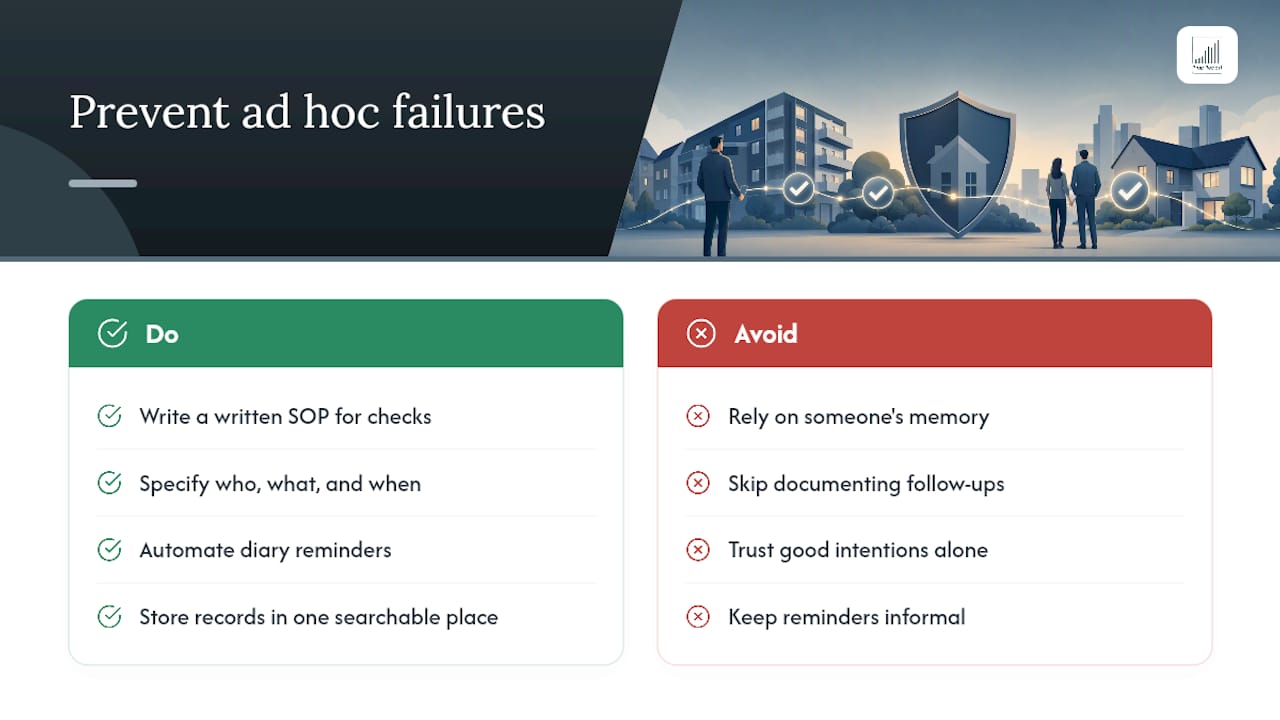
The most common failure isn't a bad initial check. It's the follow-up that never happened because nobody wrote it down properly. I've seen landlords run a flawless document check on day one and lose their statutory excuse eighteen months later purely because the reminder lived in someone's head instead of a system.
Standard operating procedures fix this more reliably than good intentions ever will. A written process that says exactly who checks, what gets stored, and when the follow-up fires removes the dependency on any one person remembering. Automating that diary logic and keeping records in one searchable place is what turns compliance from a recurring anxiety into a background task.
How Prop Report keeps your right to rent evidence audit-ready
Missed follow-up checks are rarely a knowledge problem. They're a systems problem, and that's exactly what Prop Report is built to solve.
Prop Report automates the diarising of follow-up checks against the correct statutory-excuse expiry date, so reminders fire based on the later of permission expiry or 12 months, not a guess. It centralises your check evidence, documents, share-code profiles, IDSP outputs, and LCS references, in one secure, ISO 27001-certified environment, with integration into your existing CRM so you're not maintaining a second spreadsheet alongside your main system. For landlords and agents managing more than a handful of tenancies, that centralisation is what stops a single missed reminder from turning into a civil penalty. If you want to see how the platform handles compliance evidence alongside the rest of your property operations, book a look at Prop Report for landlords and check whether it fits your current setup.
Frequently asked questions
What happens if I rent to someone without doing a right to rent check? You lose your statutory excuse and become liable for a civil penalty if that person turns out not to have the right to rent, regardless of whether you knew their status at the time.
Can I use a share code instead of checking documents? Yes, but you can't force a tenant to use one if they can provide acceptable original documents instead. Both routes are equally valid, and requiring one over the other risks a discrimination complaint under the Equality Act.
What if my tenant has an outstanding immigration application and no documents? Use the Landlord Checking Service with their Home Office reference number. A positive response gives you a statutory excuse for a defined period, so keep that response as your evidence.
How long do I need to keep right to rent records? For the duration of the tenancy and for at least 12 months after it ends, in a format that cannot be manually altered.
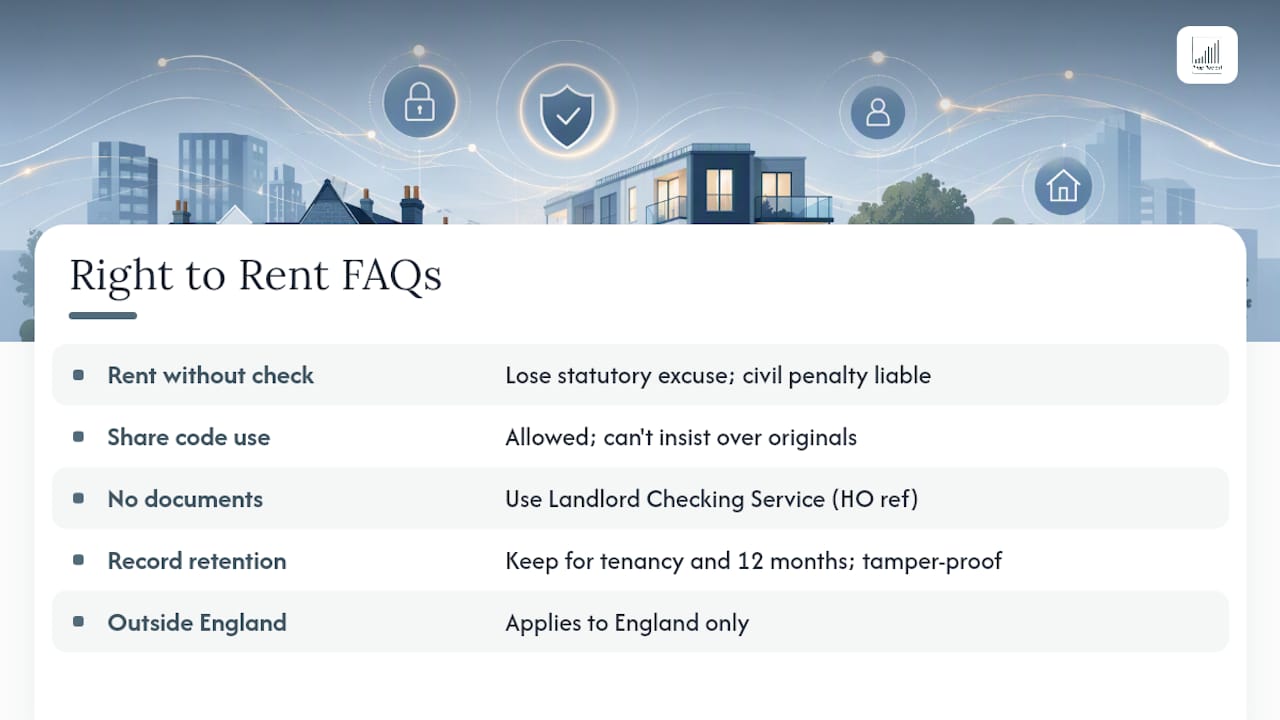
Do right to rent checks apply outside England? No. The scheme described here applies in England only; Scotland, Wales, and Northern Ireland have separate arrangements.
Sources
- Gov
- Right to rent checks: a practical guide for landlords and letting agents in England - Free Movement
Recommended
- Call Model 4 - Landlord property rentals | Streamline Landlord Marketing - Learn More — Prop Report
- Call Model 3 - Tenant Maintenance | Enhance Tenant Support - Get Started Today — Prop Report
- Call Model 2 - Tenant not maintenance or applications | Enhance Tenant Communication Today — Prop Report
- Coco Property Call Model 4 | Streamline Repairs Now — Enhance Tenant Communication — Prop Report