
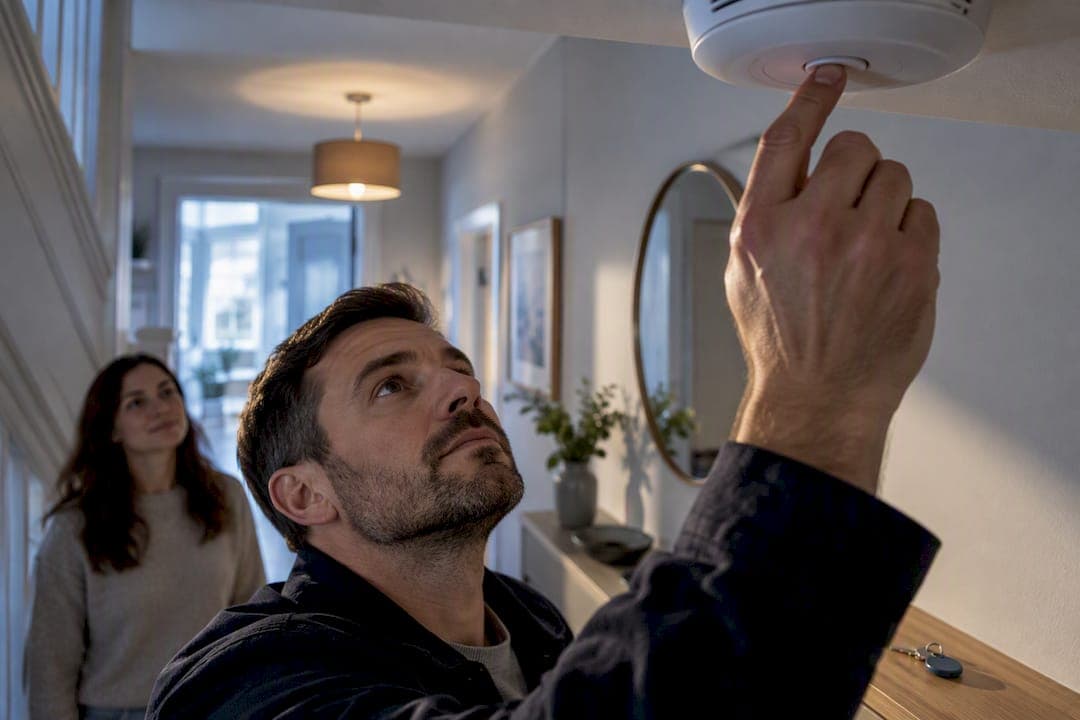
Every landlord in England must fit at least one smoke alarm on each storey used as living accommodation, plus a carbon monoxide alarm in any room with a fixed combustion appliance (excluding gas cookers). Check both work on the first day of a new tenancy and fix or replace them as soon as reasonably practicable once a tenant reports a fault. Ignore a remedial notice and a local authority can levy a civil penalty of up to £5,000.
TL;DR:
- Landlords must test smoke alarms on every storey used as living space, including converted basements and lofts, and document these checks with photos and signed checklists.
- Carbon monoxide alarms are only required in rooms with fixed combustion appliances, excluding gas cookers, and placement should be at head height near the appliance.
- Any faulty alarms reported by tenants must be fixed or replaced as soon as reasonably practicable, with documented evidence of the response to defend against enforcement.
- Enforcement involves a 21-day notice period followed by a 28-day window to rectify issues, with penalties up to £5,000 for non-compliance.
- Using a centralised compliance system can streamline recording, reminders, and evidence management, significantly reducing risk during inspections or legal proceedings.
Table of Contents
- Smoke alarm regulations UK: a quick compliance checklist
- What do the Smoke and Carbon Monoxide Alarm Regulations require?
- Enforcement, remedial notices, and the £5,000 penalty
- Practical steps to comply and the evidence to collect
- Choosing and placing smoke and carbon monoxide alarms
- Exemptions, HMOs, and other tricky cases
- Managing alarm checks with a compliance system
- Practitioner perspective: where landlords actually go wrong
- A simpler way to prove you're compliant
- Sources
- FAQ
Smoke alarm regulations UK: a quick compliance checklist
Before anything else, run through this checklist against every property you manage. It takes minutes per unit and closes off the most common enforcement triggers local housing authorities report.
- Confirm one working smoke alarm on every storey used as living accommodation, including converted lofts and basements let as bedrooms.
- Fit a carbon monoxide alarm in any room containing a fixed combustion appliance, such as a wood burner, gas boiler, or open fire (gas cookers are excluded).
- Test every alarm on the day the tenancy starts and get the tenant to sign off that they were present and working.
- Log every tenant report about a faulty alarm the moment it lands, and act on it without delay.
- Keep dated photos, receipts, and repair logs for every check and every fix, filed against the property and the tenancy.
Miss any one of these and you are exposed the moment an inspection or a complaint lands on a council officer's desk.
What do the Smoke and Carbon Monoxide Alarm Regulations require?
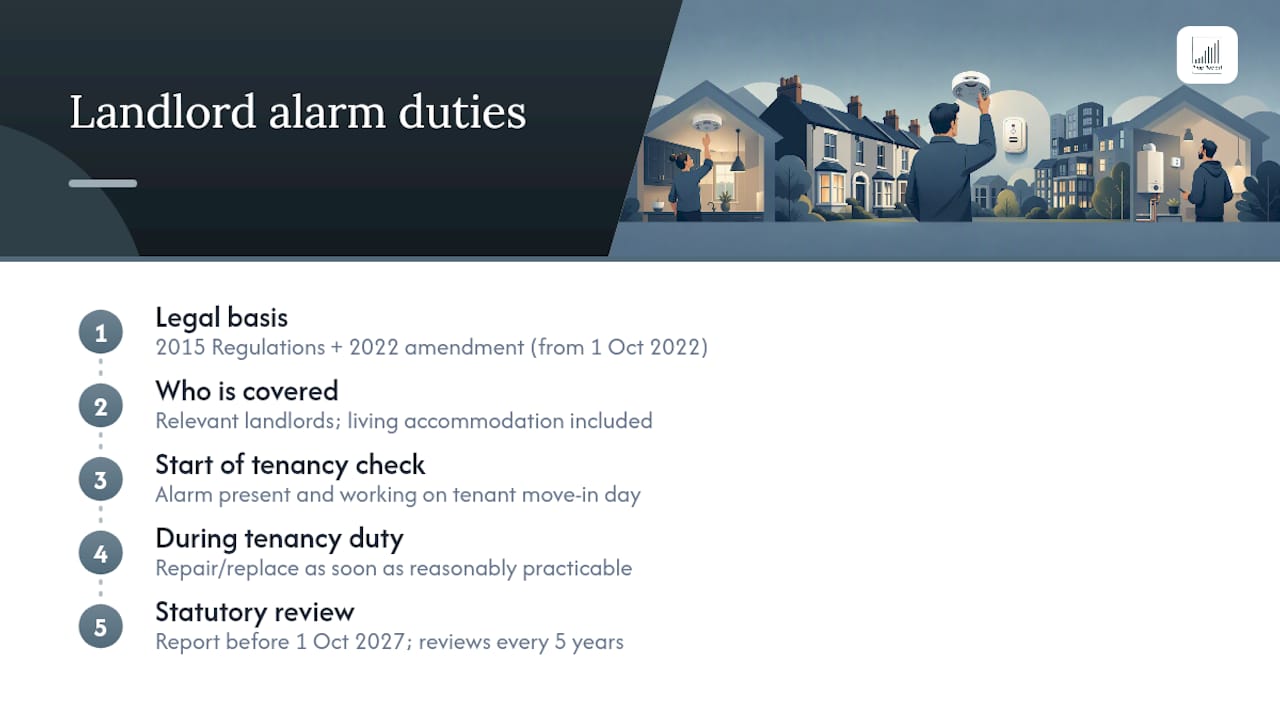
The current legal framework rests on two instruments: the Smoke and Carbon Monoxide Alarm (England) Regulations 2015, and the Smoke and Carbon Monoxide Alarm (Amendment) Regulations 2022, which came into force on 1 October 2022. Together they set out the smoke alarm requirements UK landlords must meet, and they extended coverage from private rented housing to the social rented sector too.
A "relevant landlord" is anyone letting residential property under a "specified tenancy", broadly any assured, regulated, or licensed short tenancy where the landlord is not resident in the property. "Living accommodation" covers any room a tenant actually uses to live in, not just bedrooms and living rooms. A converted garage used as a bedroom counts. A hallway does not, though it is exactly where the regulations expect a smoke alarm to sit, since alarms must be positioned to cover the escape route rather than every individual room.
The duty has two distinct moments. First, landlords must check that every required alarm is present and in working order at the start of a new tenancy, meaning the day a new tenant moves in, not the day contracts are signed. Second, the duty runs continuously: if an alarm stops working during the tenancy and the tenant tells you, the 2022 amendment requires you to repair or replace it as soon as reasonably practicable. There is no fixed number of days in the statute for that second duty, which is precisely why documentation matters so much. "As soon as reasonably practicable" is a standard a tribunal will judge against your evidence, not against your intentions.
Parliament has also built in review. The amendment requires a report on how the rules are working before 1 October 2027, with further reviews at least every five years, so this is not a static area of UK fire safety laws.
Enforcement, remedial notices, and the £5,000 penalty
Local housing authorities enforce these duties directly, and the process follows a defined sequence rather than discretionary judgement calls.
- Investigation. The authority forms a reasonable belief that a landlord is in breach, usually following a tenant complaint or a routine inspection.
- Service of a remedial notice. The authority has 21 days from forming that belief to serve the notice on the landlord.
- The 28-day window. Once served, the landlord has 28 days to comply, whether that means installing a missing alarm or fixing a faulty one.
- Representations. A landlord can make representations against the notice, which can suspend the clock while the authority reconsiders.
- Remedial action and penalty. If the landlord still hasn't complied after 28 days, the authority can arrange remedial action itself and impose a civil penalty of up to £5,000.
Landlords retain a right of appeal through the First-tier Tribunal against both the notice and any penalty. Authorised officers carrying out remedial work with occupier consent must still give 48 hours' notice before entering, so access disputes don't automatically excuse non-compliance. That 28-day window is tight if you're starting from scratch, which is exactly why proactive tracking beats reactive scrambling.
Practical steps to comply and the evidence to collect
Treat the start-of-tenancy check as a formal procedure, not a quick glance at the ceiling. Test every alarm with the tenant present, photograph each device showing it's mounted and functioning, and get a signed checklist confirming the date, the units tested, and the result. That signed document is your strongest evidence if a dispute ever reaches a tribunal.
When a tenant reports a fault, the clock on "as soon as reasonably practicable" starts immediately. Minor issues like a flat battery usually justify a same-week fix; a unit that's failed completely or is near end-of-life warrants replacement rather than a temporary patch. Either way, keep the invoice or receipt, and log the date the report came in against the date it was resolved. That gap is what an inspector or tribunal will scrutinise most closely.
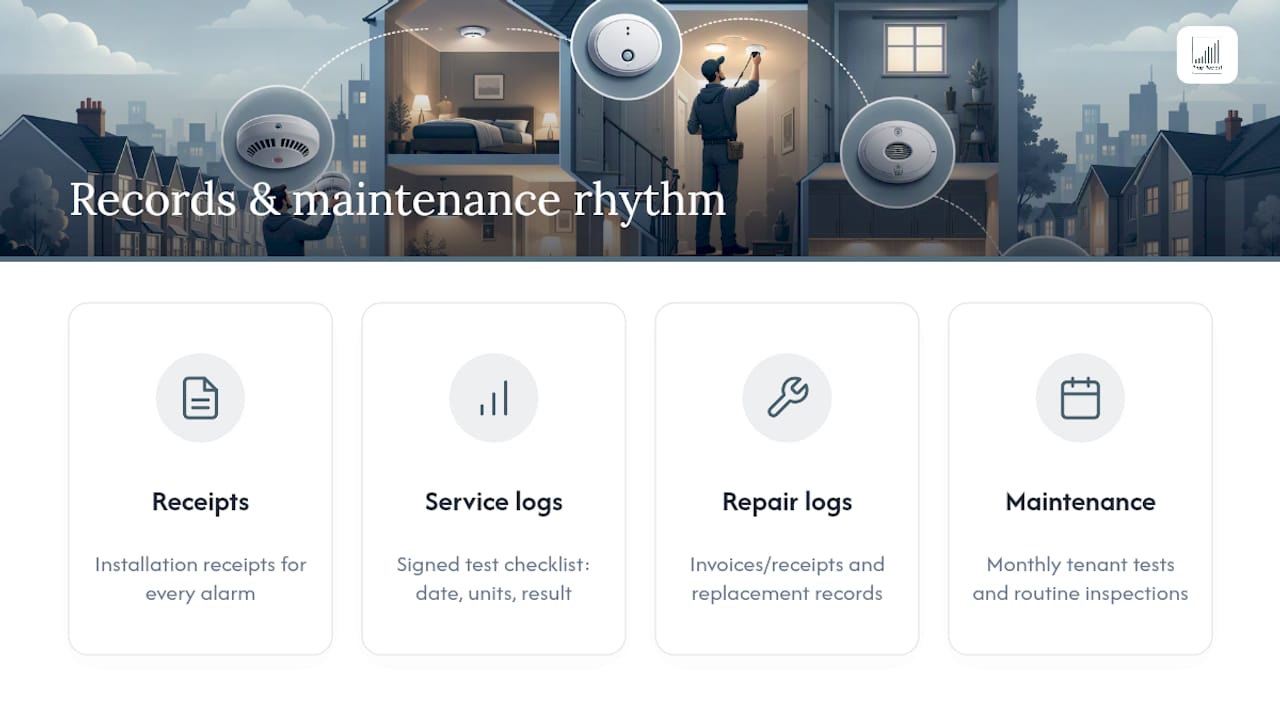
Beyond the legal minimum, build in a maintenance rhythm: ask tenants to test alarms monthly and report anything odd immediately, while you inspect and log the position and condition of every alarm at each routine visit or change of tenancy. Keep four categories of record for every property: installation receipts, service and testing records, repair or replacement logs, and copies of tenant communications about faults. Tracking repairs and tenant communication properly is what separates landlords who sail through an inspection from those who end up negotiating a penalty.
Pro Tip: Photograph the alarm's date-of-manufacture sticker at every check. Most smoke alarms have a useful life of around ten years, and a photographed date gives you an evidence trail nobody can dispute later.
Choosing and placing smoke and carbon monoxide alarms
The regulations don't dictate a specific alarm type or exact placement, but Shelter's guidance points landlords towards BS 5839-6 compliant devices and sealed-for-life battery units where mains wiring isn't an option, since sealed units remove the temptation for tenants to pull batteries for other gadgets. Fit smoke alarms on ceilings in circulation spaces such as hallways and landings, where they'll catch smoke before it reaches bedrooms. Carbon monoxide alarms belong at head height, roughly one to three metres from the appliance they're monitoring, following the manufacturer's own instructions for that specific device.
Hard-wired, interlinked systems aren't a national requirement, but they're increasingly common in HMOs and under local licensing conditions, so check your council's rules before assuming battery units will pass an inspection.
Exemptions, HMOs, and other tricky cases
A handful of situations sit outside the standard duties: resident landlords sharing the property, certain long leases of seven years or more, and specialist accommodation such as care homes or student halls with their own fire safety regime. HMO licences frequently impose stricter equipment requirements than the national minimum, particularly around interlinked alarms, so a licensed HMO landlord should check licence conditions rather than relying on the general regulations alone. Social landlords have been bound by the same core duties since October 2022, closing what was previously a gap between tenures.
Managing alarm checks with a compliance system
Spreadsheets and a memory for dates work fine for one property. They fall apart fast across a portfolio, which is where a centralised system earns its keep.
- A single compliance log captures every start-of-tenancy check, every tenant report, and every repair against the right property and date.
- Automated reminders stop the 28-day remedial window from being missed simply because a message got buried in an inbox.
- Centralised reporting gives you one place to pull evidence from if a local authority or tribunal ever asks for it.
A compliance system with ISO 27001-certified data security can give landlords and property managers real-time visibility into exactly this kind of compliance record, across every property in a portfolio rather than one at a time.
Practitioner perspective: where landlords actually go wrong
The landlords who get caught out rarely broke the law knowingly. They just tested alarms informally, waited too long after a tenant report, or kept no repair evidence at all. Document every check, act fast on every report, and preserve every receipt. Meeting the statutory minimum is the floor, not the standard to aim for.
— James
A simpler way to prove you're compliant
A specialised platform can provide landlords an alternative to chasing spreadsheets and inbox threads across a growing portfolio: one system tying start-of-tenancy checks, tenant reports, and repair history to each property automatically, avoiding evidence reconstruction under pressure.
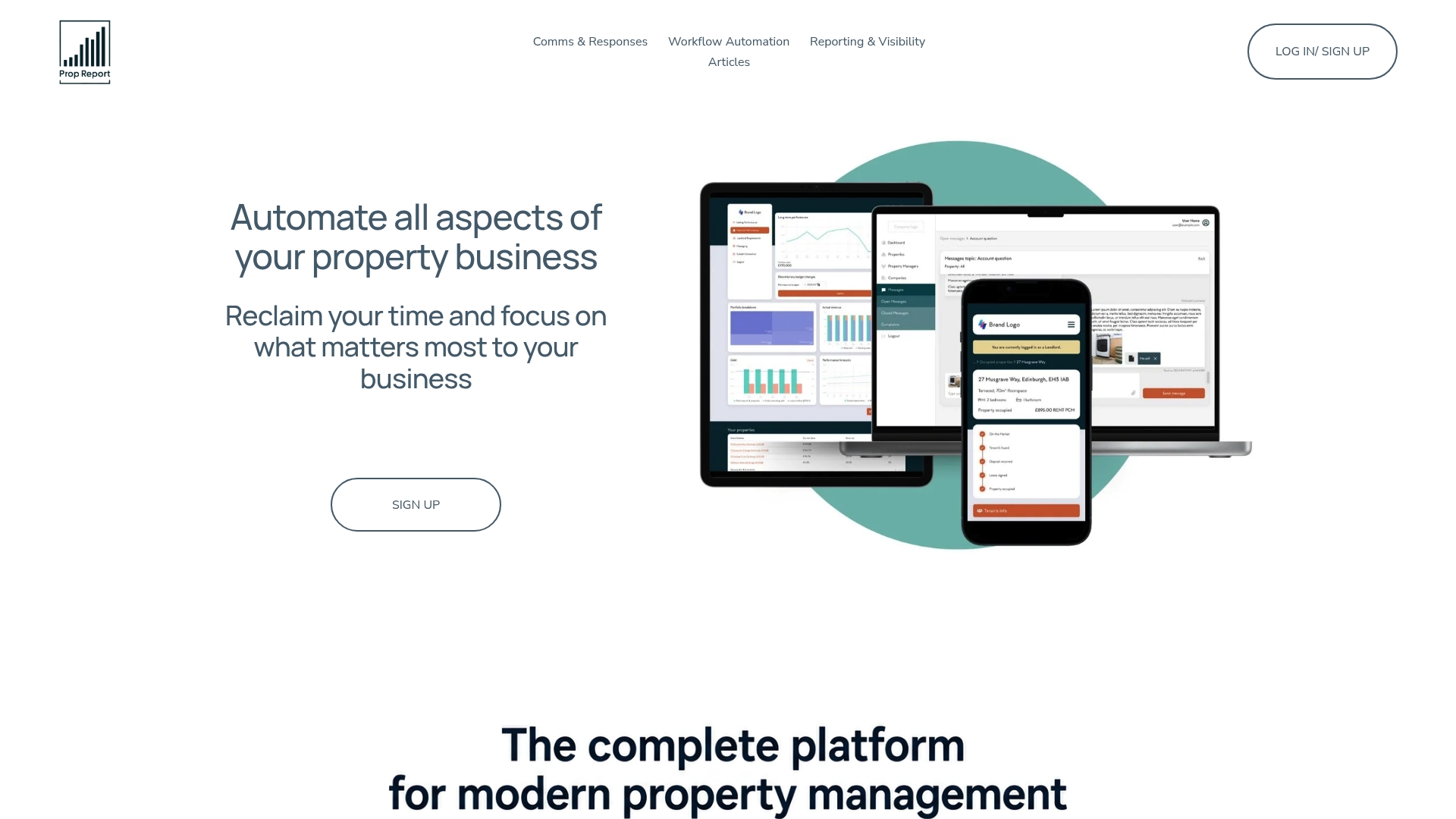
An owner portal and real-time reporting can create an audit trail the moment a check happens, supported by strong data security practices, rather than assembling information retrospectively from emails and photo rolls. This corresponds with what enforcement officers and tribunals typically require: dated proof of the check, dated proof of the fix. If you manage more than a handful of units, that structure is the difference between a five-minute response to a council enquiry and a stressful week of digging through old messages. Explore Propreport's plans or take a closer look at the landlord features to see whether it fits how you currently manage compliance.
This article is general information, not a substitute for advice from a qualified lawyer. Consult a qualified legal professional about your own circumstances before acting on anything here.
Sources
- Gov
- The Smoke and Carbon Monoxide Alarm (Amendment) Regulations 2022
- Landlord responsibility for smoke and carbon monoxide detectors - Shelter England
FAQ
Do landlords need a CO alarm in every room?
No. A carbon monoxide alarm is only required in a room used as living accommodation that contains a fixed combustion appliance, such as a wood burner or boiler, and gas cookers are specifically excluded from this duty under the 2015 Regulations as amended.
How long do I have to fix a faulty alarm?
The law requires repair or replacement "as soon as reasonably practicable" once you're notified, with no fixed number of days written into the statute. Documenting the report date and the fix date is what protects you if that timeframe is ever questioned.
What happens if I ignore a remedial notice?
The local housing authority can arrange the remedial work itself and impose a civil penalty of up to £5,000 if you don't comply within the 28-day window. You retain a right to make representations and to appeal through the First-tier Tribunal.
Do social landlords have the same duties as private landlords?
Yes, since 1 October 2022 the amended regulations extended the same smoke and CO alarm duties to social housing providers, closing a gap that previously only applied to the private rented sector.
Can Propreport help me track alarm compliance?
Propreport centralises start-of-tenancy checks, tenant fault reports, and repair records into one auditable log across your portfolio, backed by ISO 27001-certified data security. Current plans and pricing are listed on the Propreport pricing page.
Recommended
- Call Model 4 - Landlord property rentals | Streamline Landlord Marketing - Learn More
- Call Model 2 - Tenant not maintenance or applications | Enhance Tenant Communication Today
- Call Model 3 - Tenant Maintenance | Enhance Tenant Support - Get Started Today
- Coco Property Call Model 1 | Efficient Rental Management - Get Started